
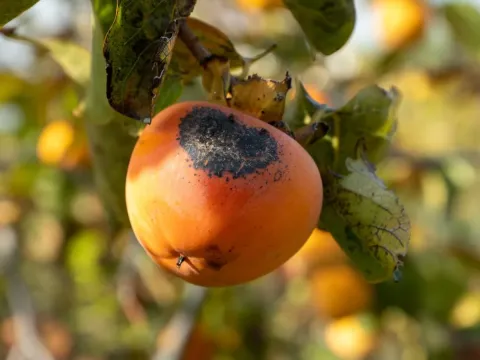
Nalanthamala canker of persimmon
Nalanthamala diospyri
The causative agent of this disease is the fungus Nalanthamala diospyri, a specialized pathogen belonging to the Ascomycota division. It is known to specifically target persimmon trees, causing significant damage to wood tissues.
What the section contains
Nalanthamala canker of persimmon
The fungus infects trees primarily through wounds, including pruning cuts, frost cracks, or injuries caused by insect borers. Once inside, the fungus invades the xylem and phloem, disrupting the tree's natural transport of water and nutrients.
The biological cycle involves the production of distinct spore masses that typically emerge on the bark surface. These spores are easily dispersed by wind, splashing rain, and contaminated tools used in the orchard.
As the mycelium colonizes the vascular tissues, it induces necrosis, leading to the death of the cambium layer. This internal colonization makes the fungus difficult to manage with surface treatments alone once it has become established.
The pathogen is highly persistent, capable of surviving within dead woody debris and necrotic bark for several growing seasons, serving as a constant source of inoculum for healthy trees.
The hallmark symptom of Nalanthamala canker is the appearance of bright pink to orange sporulation cushions or pustules on the infected bark. These structures are often visible to the naked eye during humid conditions.
The affected bark typically darkens, becomes dry, and begins to crack, forming lesions or cankers. These lesions often show a sunken center, and in advanced stages, the bark may peel away from the wood entirely.
Leaves on infected branches show signs of chlorosis, wilting, and premature drop as the vascular system becomes compromised. Over time, entire limbs may die back, leading to a stunted and sickly appearance.
If the bark is removed from an active lesion, the underlying wood often displays a characteristic browning or discoloration, indicating deep-seated necrosis.
In severe cases, the canker can girdle the trunk or main branch, which leads to the rapid death of all distal parts of the tree above the infection point.
The disease thrives in environments with high humidity and frequent rainfall, which facilitate spore production and germination. Wet weather is the most critical factor for the widespread transmission of the pathogen.
While the fungus is active over a range of temperatures, it exhibits optimal growth at moderate temperatures, typically between 18 and 25 degrees Celsius. These conditions often coincide with spring and autumn growth periods.
Orchards with high tree density, where air circulation is restricted, provide the perfect microclimate for the fungus to spread. Reduced airflow keeps the bark surface wet for longer periods, favoring infection.
Trees stressed by drought, poor soil fertility, or winter injury are significantly more susceptible to infection. Stressed trees have lower natural defenses, making it easier for the fungus to penetrate the woody tissue.
Neglected maintenance, such as leaving dead wood on trees or failing to sanitize pruning tools, creates an environment where the fungus can build up its population density over time.
Nalanthamala canker represents a major threat to both commercial persimmon production and home orchards, often leading to the permanent loss of trees if not detected early.
The economic impact involves not only the loss of fruit yield but also the high costs associated with the removal and replacement of mature, dead trees within the orchard block.
Infected trees experience a decline in overall vigor and cold hardiness, making them more vulnerable to secondary infections and environmental stresses, eventually shortening their productive lifespan.
The rapid spread of spores throughout an orchard can lead to an epidemic that affects a large percentage of the trees, necessitating rigorous and expensive management practices.
Productivity is further hampered by reduced fruit size and quality, as trees struggling with the systemic fungal infection cannot support proper ripening of the fruit.
The primary control strategy involves aggressive sanitation, which includes pruning out all infected branches at least 15–20 cm below the visible margin of the canker to ensure all diseased tissue is removed.
All infected woody debris must be promptly removed from the orchard and destroyed by burning or deep burial to eliminate sources of inoculum.
Pruning tools must be thoroughly disinfected with a 70% alcohol solution or a copper-based sanitizer between cuts on different trees to prevent the cross-contamination of spores.
- Apply copper-based fungicides during the dormant season to protect bark.
- Monitor and control wood-boring insects that create entry points for spores.
- Maintain optimal tree health through proper fertilization and irrigation.
- Promote good air circulation within the canopy through structured pruning.
Consistent preventive spraying with protective fungicides, combined with diligent monitoring and immediate surgical intervention for new infections, is essential for long-term orchard health.