
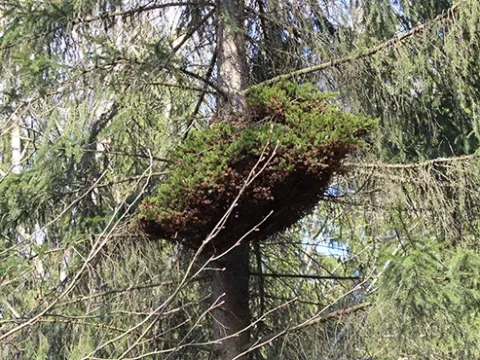
Fir broom rust
Melampsorella
The primary symptom of the disease is the formation of "witches' brooms," which are dense, stunted, and distorted clusters of branches emerging from the buds.
What the section contains
Fir broom rust
The stems in the affected areas undergo significant swelling, the bark cracks, and cankers form, resulting in a deformed appearance of the tree. These branches become brittle and are prone to breaking under snow or high wind.
During spring and summer, bright yellow-orange aecia appear on the underside of needles within the brooms. The needles in these areas are often shorter, lighter in color, and fall prematurely.
This is a chronic disease that slowly spreads through the entire crown over several years. The overall health and decorative value of the tree significantly decline as resources are redirected to the fungal growth.
Severe and long-term infections often result in the drying out of major branches, and if the main trunk is infected, the entire tree may eventually perish.
The causative agent is the rust fungus Melampsorella caryophyllacearum. It is an obligate parasite with a complex life cycle that requires two different hosts to complete.
The primary host is the fir tree, where the mycelium resides for many years, penetrating deep into the woody tissues and inducing abnormal growth. It functions as a systemic parasite capable of overwintering within the tree's living tissues.
The secondary (intermediate) hosts are herbaceous plants from the Caryophyllaceae family, such as chickweed and stitchwort, where the fungus develops during the warmer months.
The infection cycle is completed when fungal spores from the secondary host are wind-dispersed to the young needles and shoots of the fir tree. Entry is typically through stomata or mechanical bark injuries.
The fungus can persist in the forest litter and within the tissues of intermediate hosts, ensuring a continuous supply of inoculum near susceptible fir stands.
The disease thrives in conditions of high humidity and moderate temperatures, typical of coniferous forest environments. Rainfall during the spore release period greatly facilitates germination.
The presence of dense patches of chickweed or stitchwort in the vicinity of fir trees significantly increases the risk of infection. These secondary hosts act as reservoirs for the fungus throughout the growing season.
Stressed trees, whether due to poor soil conditions or pest damage, are more susceptible to initial fungal colonization. High-density planting without proper airflow creates a favorable microclimate for the pathogen.
Spores are easily carried by air currents, meaning that the disease can spread rapidly within a dense plantation. Favorable conditions for spore production are maintained throughout the first half of the summer.
Poor agricultural practices that weaken the tree's defense mechanisms contribute to the accumulation of the pathogen within the host's tissues.
This disease causes significant losses in forestry by reducing wood quality and structural integrity. Trunk infections can induce decay, rendering the wood unfit for construction.
Photosynthesis is impaired as the tree directs its energy toward supporting the pathological growths rather than normal development. This weakens the tree's immune system, making it vulnerable to secondary pests like bark beetles.
In ornamental horticulture, infected trees lose their aesthetic appeal and must often be removed, incurring costs for land cleanup and replacement of landscaping materials.
Widespread infection in forest ecosystems can lead to the degradation of fir stands, altering the structure of the local plant community as susceptible species are displaced.
The disease negatively impacts the seed-bearing capacity of the fir, as the plant's resources are diverted to sustain the fungal mycelium instead of producing healthy seeds.
The most effective control method is regular sanitation pruning of affected branches, removing the "witches' brooms" along with a segment of healthy wood to ensure complete eradication.
It is crucial to eradicate intermediate hosts—specifically Caryophyllaceae weeds like chickweed—within a 50-100 meter radius of fir plantings.
For nurseries and high-value ornamental trees, preventive spraying with copper-based fungicides during the active spore-dispersal period is recommended.
Carefully inspect all nursery stock before purchase to prevent the introduction of the fungus to your site. Any signs of pathological swelling in young seedlings should be treated as a cause for immediate isolation.
Improving tree care, providing proper fertilization, and maintaining an optimal irrigation regime help boost the tree's natural resistance to fungal pathogens.