
Mango anthracnose
Elsinoë mangiferae
Description
Symptoms
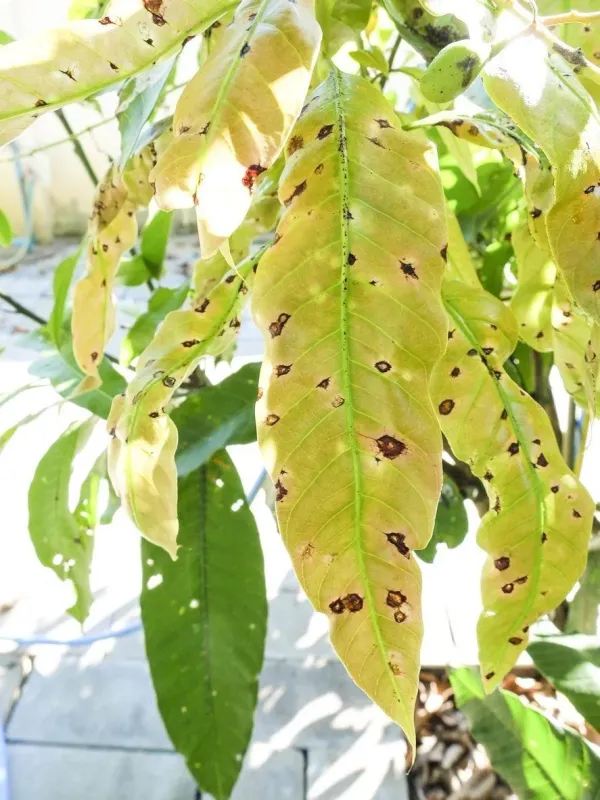
Primary symptoms include small dark spots on young leaves that rapidly enlarge. As the disease progresses, the spots turn black, often with a light halo, and the center may fall out, creating a shot-hole effect.
On young shoots, the disease manifests as elongated dark lesions, which can cause twig dieback. This is particularly dangerous for young seedlings in nurseries, where the disease can destroy most of the growth.
The most characteristic sign is the infection of inflorescences: the panicles turn black and wither, leading to complete failure of fruit set. Flowers drop off before fruit development begins.
On mature fruits, the disease appears after harvest as dark, sunken spots. Eventually, these lesions cover large parts of the fruit, causing decay and loss of marketability.
Sometimes, a pink or orange mass of spores can be seen on the surface of the lesions; this is the conidial sporulation of the fungus, which actively spreads infection to neighboring fruits during storage.
Pathogen
The causative agent of the disease is the fungus Elsinoë mangiferae, which infects almost all aerial parts of the mango tree. This pathogen belongs to the class of Ascomycetes and is highly aggressive in tropical and subtropical climates.
During its life cycle, the fungus produces spores that are easily dispersed by raindrops or wind. The infection can persist on infected branches, leaves, and fallen fruits, ensuring its survival during the off-season.
The pathogen enters plant tissues through stomata or mechanical damage to the epidermis. Mycelial development within the tissues leads to cell destruction and the appearance of characteristic necrotic spots.
Microscopic examination of samples reveals fungal fruiting bodies developing directly within the epidermis. Severe infection can lead to systemic colonization, causing general decline of the tree.
Studying the biology of Elsinoë mangiferae is crucial for developing chemical control strategies, as the fungal spores exhibit high resistance to various environmental stresses.
Conditions for development
High humidity and frequent rainfall are the primary drivers of infection. Rain promotes the spread of fungal spores from the upper canopy to lower parts of the tree.
The optimal temperature range for active reproduction is between +20 and +28 degrees Celsius. Outbreaks of the disease are most frequently observed during periods of prolonged wet weather.
Poor canopy ventilation significantly increases the risk of disease spread. Dense plantings create a microclimate with high humidity, which favors the germination of spores on leaves.
Poor agricultural practices, such as incorrect irrigation or lack of pruning, make trees more susceptible to fungal attacks. Weakened trees lack the resources to resist mycelial colonization.
Large amounts of plant debris left under trees create a reservoir for the infection. Fungal spores can maintain viability in the soil or leaf litter for a long period.
Why it matters
The primary damage is the massive loss of fruit quality, rendering them unsuitable for the fresh market. Decay of infected fruits occurs extremely rapidly.
Infection of inflorescences leads to a catastrophic reduction in yield, as fruits fail to set. This causes direct economic losses for agricultural enterprises.
Constant damage to young shoots leads to canopy deformation and general tree exhaustion. Over time, such trees stop producing and may eventually die.
The spread of the disease during post-harvest storage leads to significant losses during logistics. Even externally healthy-looking fruits may carry latent infections that appear under changing temperature conditions.
The need for frequent chemical treatments increases production costs and places a greater burden on the environment, which is a significant factor for sustainable farming.
Protection
The foundation of control is regular sanitary pruning, aimed at removing and burning all infected plant parts. This reduces the inoculum level in the orchard.
It is recommended to follow planting schemes that ensure good canopy aeration. Proper air circulation prevents moisture stagnation, which slows down fungal spore development.
The application of copper-based fungicides is a standard preventive practice. Treatments should be applied during critical phenological stages, especially during flowering.
The use of systemic fungicides is effective during periods of high humidity. These products penetrate plant tissues and stop mycelium development from within.
- Strict enforcement of quarantine measures for planting material.
- Regular application of copper fungicides.
- Removal of infected fruits and fallen leaves.
- Timely thinning of the canopy to improve ventilation.
Discussion
No discussions yet — be the first.