
Maize bushy stunt
Maize bushy
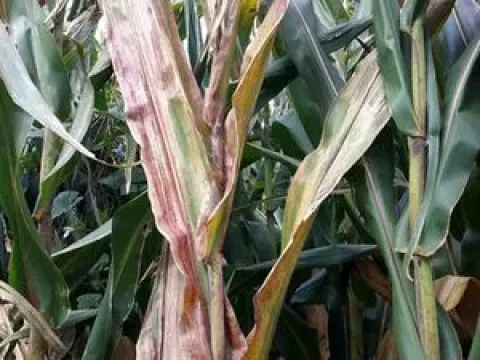
The primary symptom of this disease is abnormal tillering, where numerous secondary shoots sprout from the leaf axils. This gives the maize plant a stunted, bushy appearance that deviates significantly from its natural growth habit.
What the section contains
Maize bushy stunt
Leaves on infected plants typically show yellowing, narrowing, and shortening compared to healthy foliage. Chlorosis or a reddish-purple discoloration of the leaves is also common, indicating severe metabolic dysfunction.
The main stem growth is severely retarded, causing the plant to remain stunted. These infected plants are easily identifiable within a field due to their stunted height and dense, vegetative mass.
Reproductive development is profoundly hindered in affected plants. Ears either fail to form entirely or develop into small, deformed structures that have no commercial value and produce little to no viable grain.
Root system development is poor, making the plants highly susceptible to water stress and nutrient deficiency. Consequently, infected plants often wilt quickly, even when soil moisture levels are adequate for healthy crops.
The causal agent of Maize bushy stunt is a phytoplasma, a small prokaryotic organism devoid of a cell wall. These pathogens exclusively inhabit the phloem tissue of the host plant.
As a systemic disease, the phytoplasma colonizes the entire vascular network of the maize plant. The infection spreads throughout the stem, leaves, and roots, disrupting the transport of nutrients and photosynthates.
The transmission of this pathogen is highly specialized and relies entirely on insect vectors, primarily leafhoppers. The pathogen circulates within the vector before being transmitted to healthy plants.
The biology of the pathogen is intrinsically linked to the leafhopper lifecycle. Once an insect acquires the phytoplasma from an infected plant, it remains a carrier for the rest of its life, continuously spreading the infection.
Diagnosis is challenging because phytoplasmas cannot be cultured in standard laboratories. Molecular techniques, such as PCR (Polymerase Chain Reaction), are required to confirm the presence of the pathogen in plant tissues.
The prevalence of the disease is directly tied to the population density of the insect vectors. Large populations of leafhoppers in the field dramatically increase the likelihood of widespread plant infection.
Warm and humid weather conditions foster the reproduction and movement of leafhoppers. These conditions are optimal for the spread of the pathogen throughout the maize crop during the early vegetative stages.
The presence of weeds in and around the field is a major risk factor. Weeds act as reservoirs for both the phytoplasma and the leafhoppers, allowing the disease to persist even when maize is not present.
Temperature fluctuations during the planting season significantly impact the disease incidence. Early infection of young seedlings is the most dangerous, as it leads to more severe yield loss compared to late-season infections.
Continuous cropping of maize in the same area creates an ideal environment for the buildup of both vectors and the pathogen. This lack of crop rotation is a major contributor to chronic disease outbreaks.
Maize bushy stunt is a highly destructive disease capable of causing total crop failure in heavily infested areas. Infected plants rarely contribute anything to the final harvest yield.
The yield loss occurs because the plant diverts its energy into producing useless vegetative tillers instead of developing grain-bearing ears. This metabolic diversion leads to stunted plants and empty or barren ears.
Productivity is also impacted by the overall weakness of the crop, which makes it more susceptible to lodging and secondary infections. This compromises both the quantity and the quality of the harvested grain.
The lack of uniformity in the field, caused by patches of stunted plants, makes mechanical harvesting difficult. This leads to increased grain losses during combine operations and operational inefficiencies.
Economic impact includes significant revenue loss due to reduced yields and the high costs associated with insect control programs. Management is necessary to maintain the economic viability of maize production.
The most effective management strategy involves controlling the leafhopper population using timely insecticide applications. Monitoring vector density early in the season is critical for successful suppression.
Maintaining weed-free fields and surroundings is essential to remove reservoirs of both the vector and the phytoplasma. Eliminating alternative hosts effectively breaks the disease cycle.
Crop rotation is a standard agricultural practice that helps reduce the pressure of the disease by interrupting the persistence of the pathogen in the soil and local ecosystem.
Using certified seed and implementing spatial isolation between old, infected fields and new plantings can help delay or prevent initial infections during the critical early growth stages.
- Regular monitoring of leafhopper populations.
- Targeted insecticide spray programs.
- Rigorous weed control in and around fields.
- Implementation of crop rotation cycles.
- Planting resistant or tolerant hybrid varieties.