
Description
Symptoms
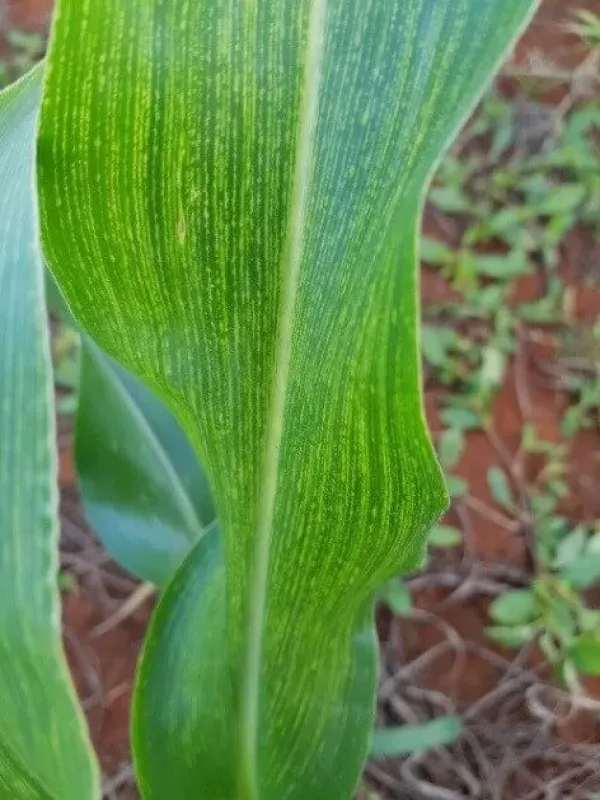
The first clinical signs of Maize rayado fino include small, chlorotic spots appearing at the base of young leaves. These spots gradually elongate into fine, dotted streaks running parallel to the leaf veins.
As the infection progresses, these streaks become more prominent and confluent, creating a distinct "rayado" or striped pattern that is visible against the normal green color of the leaf.
Infected plants typically exhibit significant growth stunting. Shortened internodes and reduced leaf expansion give the plant a dwarfed appearance compared to healthy, vigorous specimens in the same field.
Reproductive development is severely compromised; infected plants often produce smaller ears with poorly filled tips. In severe cases, the ears may fail to develop kernels entirely, leading to total yield loss.
In some susceptible hybrids, leaves may show signs of reddening or yellowing in the later stages of infection, which is often associated with the breakdown of chlorophyll and general plant decline.
Pathogen
The causative agent of this disease is the Maize rayado fino virus (MRFV), a member of the genus Marafivirus. It is a viral pathogen that exclusively infects corn plants and certain wild grass species.
The virus is characterized by a positive-sense single-stranded RNA genome. It cannot persist in the soil or crop debris, meaning its survival between seasons depends entirely on its vectors or perennial host plants.
The primary vector for the transmission of MRFV is the corn leafhopper, Dalbulus maidis. This insect acquires the virus after feeding on infected plants and retains the ability to transmit it throughout its entire life span.
The transmission process is persistent and circulative, meaning the virus must pass through the insect's gut and reach the salivary glands before it can be injected into healthy host tissue during feeding.
Once introduced into the plant tissue, the virus replicates systemically, spreading through the vascular system (phloem) and causing characteristic physiological changes in the development of the corn plant.
Conditions for development
The spread of Maize rayado fino is intrinsically linked to the population dynamics of the Dalbulus maidis leafhopper. High temperatures and moderate humidity favor rapid insect multiplication and movement.
The disease incidence is highest in areas where corn is planted continuously throughout the year, as this provides a constant supply of fresh host tissue for the leafhopper population.
Wild grasses and volunteer corn plants act as reservoirs for the virus. When leafhoppers move from these neglected areas into cultivated fields, they introduce the virus to young, vulnerable corn seedlings.
Early-stage infection is the most critical; seedlings that are exposed to viruliferous leafhoppers shortly after emergence are the most severely impacted in terms of final height and yield potential.
Environmental stress, such as drought or nutrient deficiency, may exacerbate the symptoms of the virus, making the plants appear more withered and reducing their resilience against the infection.
Why it matters
The economic impact of Maize rayado fino is primarily due to a significant reduction in grain yield. By impairing the plant's ability to photosynthesize, the virus limits the production of carbohydrates needed for grain filling.
Yield losses can vary widely depending on the resistance level of the corn hybrid, but major outbreaks can result in yield reductions ranging from 20% to over 50% in highly susceptible varieties.
Beyond quantity, the quality of the harvest is often affected. Grain from infected plants may be smaller, lighter, and possess lower nutritional density, which impacts its value for animal feed production.
The overall susceptibility of the crop to secondary pathogens, such as ear rots and stalk rots, increases as the plants' defense systems are weakened by the viral invasion.
Costly management practices, including intensive insecticide application to control the leafhopper population, significantly increase the production cost for the grower, further impacting overall profitability.
Protection
The most effective strategy for managing Maize rayado fino is the use of resistant or tolerant corn hybrids. Breeding for resistance remains the cornerstone of integrated pest management for this virus.
Effective control of the leafhopper vector using systemic insecticides is essential during the early stages of corn development to prevent the initial infection of young seedlings.
Sanitation practices, such as the removal of volunteer corn and susceptible weeds in and around the fields, are crucial to break the virus's life cycle and reduce the local inoculum source.
Adjusting planting dates to avoid the peak periods of leafhopper migration is a common cultural practice used to reduce the probability of early infestation by viruliferous insects.
Spatial isolation between fields with different planting dates helps to reduce the rate of virus movement, limiting the potential for secondary spread across large farming operations.
Pathogens and affected parts
Affects crops · 1
Discussion
No discussions yet — be the first.