
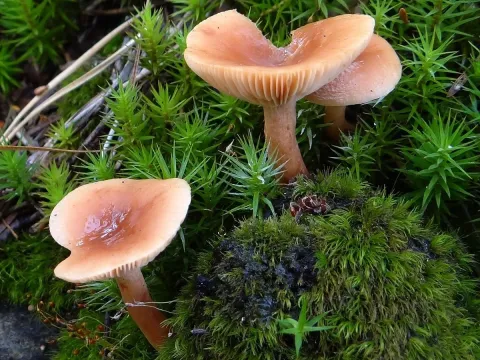
Orange milkcap
Lactarius tabidus
Orange milkcap (Lactarius tabidus) is a mushroom species belonging to the family Russulaceae. It is strictly a forest-dwelling fungus and is not considered a plant pathogen or a disease agent in agricultural systems.
What the section contains
Orange milkcap
The fungus functions as an ectomycorrhizal symbiont. This relationship involves the fungal mycelium colonizing the root tips of trees, which is beneficial for forest health and tree growth.
Unlike parasitic fungi that infect and kill host tissues, Lactarius tabidus lives in mutualistic harmony with various tree species, including birch and conifers. It does not threaten crops or orchards.
The morphology of the fungus consists of a cap ranging from 2 to 5 cm in diameter, a stalk, and gills. It is known for its relatively small stature and reddish-brown coloration.
A distinctive biological feature is the latex (milk) produced when the gills are damaged. This fluid is initially white and gradually turns yellow, which serves as a primary field identification characteristic.
The primary sign of the fungus's presence is the emergence of fruiting bodies during wet periods. The cap often has a small, prominent bump (umbo) in the center, which is a common feature for this species.
The gills are adnate or slightly decurrent and are pale yellow or ochre in color. When bruised or cut, the gills exhibit the characteristic latex-to-yellow color change typical of the species.
The stalk is slender, often becoming hollow as the mushroom matures. The color of the stalk usually matches the cap, though it may appear slightly lighter in shade near the base.
The flesh of the mushroom is thin and brittle. It lacks a strong odor, though some observers note a subtle earthy smell associated with the habitat where it grows.
Microscopically, the spores are hyaline and ornamented with ridges, which can be observed under higher magnification. The spore print is typically a pale cream or yellowish-white color.
Lactarius tabidus thrives in damp, acidic soil environments. It is frequently observed in coniferous and mixed forests where there is an abundance of leaf litter or moss.
The optimal season for fruiting is from mid-summer through late autumn. High precipitation and moderate temperatures are critical for the formation of the mushroom's reproductive structures.
The fungus is highly dependent on the host tree's root system for carbon sources. It is seldom found far from the root zones of birch, spruce, or pine trees.
Shaded microclimates are essential for the survival of the mycelium. Direct sunlight and dry conditions inhibit the development of the fruiting bodies, leading to rapid desiccation.
Distribution across forest ecosystems is facilitated by the release of spores that travel on air currents or are dispersed by small invertebrates inhabiting the damp leaf litter.