
Orange Stropharia
Stropharia aurantiaca
Description
Symptoms
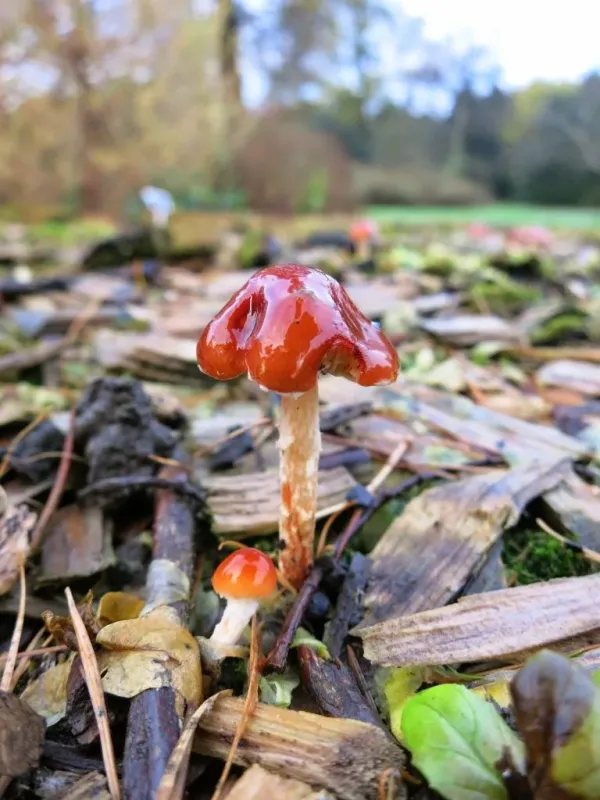
The most visible indicator of this fungus is the emergence of bright orange to reddish-orange mushrooms near the base of plants or within mulched areas, usually following periods of high moisture.
Close inspection of the soil surface often reveals dense networks of white mycelial threads. These threads may appear to bind the soil particles together or colonize pieces of decaying organic matter.
In cases where the fungus is in direct contact with plant roots, darkened or discolored tissues may be observed at the root collar. This indicates that the mycelium is interacting with the plant's surface tissues.
Identification is easiest during the fruiting phase when the characteristic orange caps and the presence of a ring (annulus) on the stalk are clearly visible to the agronomist.
In early stages, the mycelium can be mistaken for other beneficial or pathogenic fungi. However, the consistent, specific morphology of the fruiting bodies allows for precise field identification.
Pathogen
Orange Stropharia (scientific name Stropharia aurantiaca, synonym Leratiomyces ceres) is a species of fungus in the family Strophariaceae. In an agricultural context, it typically behaves as a saprotrophic organism that thrives on organic matter-rich soils, mulch, or decaying woody debris.
While this fungus is generally not categorized as a primary pathogen of healthy crops, it can act as an opportunist under unfavorable soil conditions. Its presence indicates high organic content and potential issues with drainage or microbial balance in the soil profile.
The organism reproduces through spores dispersed by wind and water. Once established in a substrate, its mycelium spreads rapidly, colonizing the area and utilizing available nutrients for its development.
As a basidiomycete, this fungus possesses highly efficient enzymes capable of breaking down complex organic molecules, including lignin and cellulose, which are abundant in garden mulches and composted materials.
Its biological impact is primarily related to its role as a decomposer. However, in dense agricultural settings, it can compete with plant roots for water and essential minerals, indirectly affecting crop vitality.
Conditions for development
Development is heavily dependent on soil moisture levels. Stropharia aurantiaca thrives when soil moisture exceeds 60% capacity, making it a common sight in over-irrigated garden beds.
Moderate temperatures ranging from 15°C to 22°C (59°F to 72°F) create the perfect environment for the mycelial growth and rapid production of fruiting bodies across the site.
Organic-rich substrates, particularly those containing wood chips, sawdust, or fresh straw, are highly conducive to the establishment and spread of this fungal colony.
Poor soil aeration and compaction significantly enhance the fungus's ability to proliferate. A lack of oxygen in the soil prevents beneficial aerobic microbes from competing effectively with the Stropharia.
Fluctuations in pH levels, particularly toward acidic ranges, may weaken the soil's natural microbial defenses, allowing Stropharia aurantiaca to dominate the immediate environment.
Why it matters
Direct damage is typically low, but competition for nutrients is the primary concern. The fungus consumes carbon and nitrogen sources that are otherwise intended for plant growth.
High mycelial density can inhibit water absorption by plant roots. By coating the root system, the fungal network acts as a physical barrier, potentially leading to nutrient deficiency symptoms.
In intensive cultivation systems, the fungus can contribute to a damp, humid microclimate around the plant base, which increases the susceptibility of the crop to opportunistic bacterial infections.
Young transplants are particularly vulnerable. When the mycelium overgrows the area around a tender root system, it can cause stunting or secondary rot, especially if the plants are already stressed.
Overall, while it is not a devastating pathogen, the presence of Orange Stropharia signifies an unbalanced soil ecosystem that can negatively influence long-term crop yields and uniformity.
Protection
The most effective management strategy involves cultural practices: avoid over-watering and ensure adequate soil drainage to prevent the moisture levels the fungus requires.
Limit the application of fresh, non-composted wood mulch. Ensure that all organic materials added to the soil are fully decomposed to minimize the fungal substrate.
Biological controls such as introducing Trichoderma species can be highly effective. These beneficial fungi outcompete Stropharia aurantiaca for resources in the soil.
Physically removing the mushrooms before they release spores is a simple yet effective way to limit the fungal population for subsequent growing seasons.
- Improve soil drainage and aeration.
- Use fully composted mulch.
- Incorporate beneficial biological agents.
- Regular monitoring for fruiting bodies.
Discussion
No discussions yet — be the first.