
Herpomyces
Herpomyces
Herpomyces is a genus of specialized ectoparasitic fungi within the order Laboulbeniales. Unlike typical agricultural pathogens, these fungi do not infect plant tissues but instead exist as obligate parasites on the surface of arthropods, most notably beetles and cockroaches.
What the section contains
Herpomyces
The fungus develops a complex structure called a thallus, which attaches itself to the host's exoskeleton. It feeds by inserting a haustorium into the insect's hemocoel, allowing for the absorption of nutrients while keeping the host alive to ensure the fungus can complete its life cycle.
Biology of the genus is marked by extreme host specificity. Many species are restricted to specific insect hosts, meaning their distribution is tightly linked to the population dynamics and behavior of those insects within a given habitat.
Transmission occurs exclusively through direct physical contact between insects. As individuals move and interact, fungal spores are transferred from infected to healthy hosts, a process highly dependent on the host density in the environment.
In agronomy, Herpomyces is studied primarily for its ecological role. While it does not attack crops, it serves as a natural regulator of insect populations, which is an important consideration in integrated pest management (IPM) strategies.
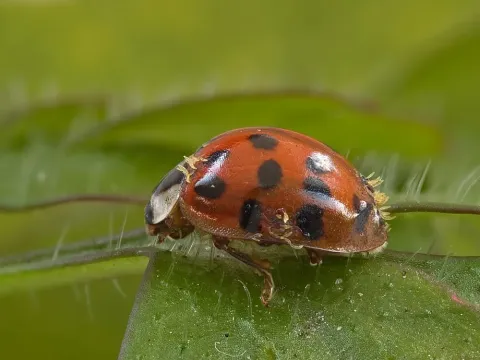
The most visible sign of a Herpomyces infection is the presence of small, dark, hair-like structures protruding from the insect's body. These are the perithecia (fruiting bodies) of the fungus, which are firmly anchored to the chitinous cuticle.
Infections typically manifest on specific parts of the insect's body, such as the antennae, legs, or elytra. In heavy infestations, these accumulations appear as a dense, dark forest of micro-structures that can be easily identified with a magnifying glass.
Diagnostics for this fungus require microscopic examination. Because individual fruiting bodies are often only a few hundred micrometers in size, detection without a lens or microscope is nearly impossible in the field.
Infected insects often show no initial change in behavior. However, heavy loads of the fungus can affect the insect's movement or grooming efficiency, as the fungus creates physical drag and may impact sensory organs like antennae.
The extent of infestation is measured by the number of thalli present on the host. In scientific studies, this is used to quantify the spread of the parasite within an insect population and the efficiency of transmission.
Growth and reproduction of Herpomyces are highly dependent on environmental humidity. High humidity levels, which often coincide with the active seasons of the insect hosts, are optimal for spore germination and the development of new fruiting bodies.
Host population density is the most critical factor for the spread of the fungus. A higher concentration of insects in a localized area leads to more frequent contact, which facilitates the rapid spread of the parasite throughout the population.
Temperature significantly influences the maturation rate of the perithecia. Environments that are stable and warm, such as greenhouses or protected cultivation sites, can accelerate the life cycle of the fungus significantly.
Agricultural chemical treatments, particularly fungicides, can inadvertently inhibit the development of Herpomyces. If these chemicals are applied broadly, they can suppress natural entomopathogenic fungi, potentially disrupting natural biological control mechanisms.
Seasonality dictates the presence of the fungus. Peaks in insect population numbers naturally lead to peaks in Herpomyces prevalence, making it a dynamic part of the biological landscape in agricultural fields.
Herpomyces poses no direct threat to agricultural crops. It is not a plant pathogen, and therefore it does not cause damage to plant tissues, fruits, or yields, meaning it does not require intervention from farmers.
There is a potential ecological concern regarding its impact on beneficial insects, including pollinators or predators. If the fungus affects these species, it could potentially weaken natural pest-control populations, though this effect is usually localized.
No economic harm has been attributed to this genus. On the contrary, researchers study it as a model for insect-pathogen co-evolution and as a potential component of sustainable pest management programs.
In certain contexts, the energetic cost to the insect host of maintaining a fungal colony could theoretically reduce its reproductive success. This suggests that Herpomyces may have a subtle, negative impact on pest populations.
Ultimately, the impact of the fungus is considered neutral to slightly beneficial. Its presence is generally a sign of a healthy, complex ecosystem where natural parasites help maintain a balance among various insect populations.
Control measures against Herpomyces are not required in agricultural practice. Since the fungus does not damage crops, any attempt to eradicate it would be unnecessary and potentially detrimental to local biological diversity.
To preserve beneficial entomopathogenic fungi, farmers should be mindful of fungicide use. If it is known that natural parasites are helping to control pest populations, selecting targeted pesticides over broad-spectrum ones is recommended.
Monitoring for the presence of such fungi can be a useful tool for assessing the biological status of a crop environment. It helps to understand the natural pressures that keep pest populations in check throughout the growing season.
For indoor insectaries or laboratory settings, preventing the spread of Herpomyces involves maintaining optimal hygiene and controlling insect density, which minimizes the environment conducive to fungal proliferation.
The best approach to managing this organism is the maintenance of an ecological balance. Supporting biodiversity allows natural regulators to flourish, reducing the need for chemical interventions and creating a more stable agrosystem.