
Heterobasidion root rot
Heterobasidion parviporum
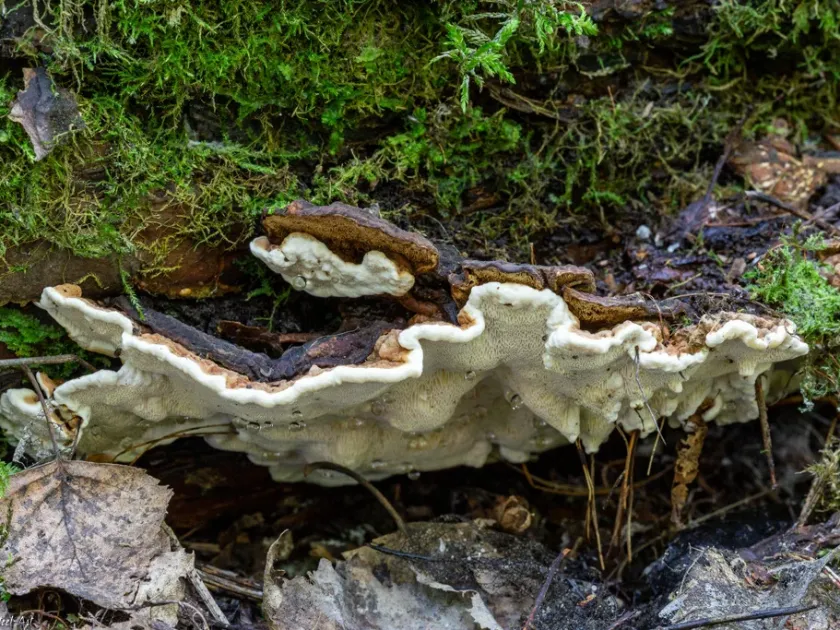
Description
Symptoms
Symptoms often go unnoticed until the disease is well advanced. Early signs include thinning of the crown, chlorosis (yellowing of the needles), and a significant reduction in annual radial and height growth as the tree's nutrient uptake is compromised.
Excessive resin flow at the base of the trunk is a common defensive response of the spruce. When this resin mixes with soil particles at the root collar, it forms dark, hardened crusts that are visible upon close inspection.
Fruiting bodies of the fungus may appear at the base of the tree, usually hidden under needles or within bark crevices. They are bracket-like or flat structures, brown on the upper side and creamy-white on the underside, indicating active spore production.
When an infected tree is felled, the cross-section reveals the internal extent of the rot. It appears as a reddish-brown decay, often accompanied by white mycelial pockets and distinct black zone lines that mark the boundary between healthy and infected wood.
Windthrow is a classic late-stage sign. Because the root system is severely weakened, infected trees are prone to toppling over during strong winds. Exposed, rotten roots with shredded wood fibers are clear evidence of advanced root rot damage.
Pathogen
The causal agent of this disease is the wood-decaying fungus Heterobasidion parviporum, a specialized basidiomycete. It primarily attacks Norway spruce, causing severe root and butt rot, which is a major threat to commercial forestry across the Northern Hemisphere.
Classified as a root and butt rot, the fungus invades the tree through wounds or root contacts. Once inside, it produces specialized enzymes that break down lignin and cellulose, leading to a progressive decay of the wood structure, which destroys the tree's internal integrity.
The fungus produces basidiospores on the fruiting bodies. These spores are dispersed by the wind and infect fresh stump surfaces or exposed roots, initiating the colonization process that can last for several decades within a forest stand.
The pathogen spreads vegetatively through root grafting between infected and healthy trees. This mycelial growth allows the fungus to move from one tree to another without the need for spore production, creating expanding infection gaps known as "infection centers."
This fungus is highly persistent. It can survive in dead stumps and roots for a long time, acting as a reservoir of infection that constantly threatens newly planted trees if the soil is not properly treated or managed.
Conditions for development
Development of the fungus is favored by warm, humid weather conditions, which promote spore germination and mycelial growth. Forests with poor drainage or compacted, waterlogged soils are particularly susceptible to widespread infection.
Pure spruce stands (monocultures) provide the ideal environment for the pathogen. High planting density leads to frequent root contacts, which facilitates the rapid spread of the mycelium throughout the entire forest patch.
Human activities, especially forestry operations, significantly contribute to the spread. Machinery that damages roots or bark creates entry points for spores, and the creation of stumps during logging provides immediate landing sites for airborne spores.
Seasonal factors are crucial; the pathogen is most active during the growing season. Infections are significantly more likely if pruning or thinning is performed during periods of high spore release rather than in the dormant winter months.
Environmental stress, such as drought or pollution, further weakens the trees' natural defense mechanisms, making them significantly more vulnerable to colonization by Heterobasidion parviporum than healthy, vigorous trees.
Why it matters
The primary economic harm is the extensive loss of timber volume and quality. Butt rot degrades the most valuable part of the tree trunk, making it unsuitable for sawmilling or high-quality construction purposes.
Beyond economic losses, the disease poses a serious safety risk in public forests and recreational areas due to the high likelihood of windthrow, which can result in unpredictable falling of trees.
Heterobasidion root rot causes long-term site degradation. Once an infection center is established, it can persist for decades, making it extremely difficult to successfully reforest the area with susceptible spruce species without long fallow periods.
The disease reduces the ecological stability of the stand, making it easier for secondary pests, such as bark beetles, to attack and kill trees that are already suffering from impaired root health.
Management of the disease requires intensive and costly interventions, including early salvage logging and the removal of stumps, which burdens forest management budgets and disrupts natural forest development cycles.
Protection
To minimize damage, foresters emphasize avoiding mechanical damage to roots and stems during thinning. Operations should be planned for the winter months when temperatures are low enough to inhibit spore germination.
Biological control is a standard and effective practice. Treating freshly cut stump surfaces with spore suspensions of the competitive fungus Phlebiopsis gigantea prevents Heterobasidion from colonizing the stump, effectively protecting the stand.
Promoting mixed-species stands is a key preventive strategy. By interplanting deciduous trees among spruces, foresters create physical and biological buffers that impede the spread of the mycelium through the roots.
In cases of severe infestation, sanitary felling is necessary to remove the source of infection. This involves identifying and cutting infected trees, sometimes extending to the removal of stumps in heavily affected patches.
Site selection and matching species to the environment are crucial. On high-risk sites where the disease is prevalent, foresters may opt to plant resistant species like pine or broad-leaved trees instead of re-establishing spruce.
Discussion
No discussions yet — be the first.