
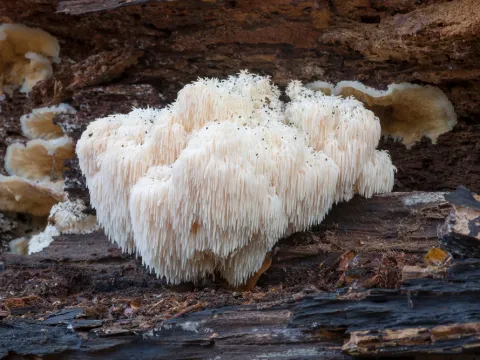
Lion's mane mushroom
Hericium erinaceus
Hericium erinaceus, known as the lion's mane mushroom, is a unique basidiomycete fungus. While widely cultivated for culinary and medicinal use, in forest ecosystems, it acts as a facultative parasite.
What the section contains
Lion's mane mushroom
The pathogen spreads through its mycelium, which invades the woody parts of the tree, typically entering through broken branches, bark fissures, or pruning wounds. It utilizes wood as its primary nutrient source.
The disease caused by this fungus is characterized as white rot. It produces enzymes that break down both lignin and cellulose, significantly weakening the structural integrity of the affected wood.
It predominantly targets hardwood species such as oak, beech, and walnut. It does not pose a threat to standard field crops but is a significant factor in the decay of old or injured forest trees.
The fungus is identifiable by its distinctive, dangling, icicle-like spines, which are unique within the Hericiaceae family, contrasting with the traditional cap-and-stem structure of most mushrooms.
The most prominent sign of infestation is the emergence of white, fleshy, globular fruit bodies on the trunk or crotches of branches. These are often described as having a cascading, bearded appearance.
Internal wood infection manifests as a lightening of the wood color and a change in texture, which becomes soft and fibrous due to the depletion of structural polymers like lignin.
Affected trees may display necrosis around the infection site on the bark. In advanced stages, deep cracks or hollows may form where the mycelium has extensively consumed the wood.
Limb fragility is a critical indicator; branches that appear healthy from a distance may become brittle and break easily during moderate winds due to internal rot.
Visible fruit bodies indicate that the fungus has been established within the tree for several years, as the vegetative stage occurs deep inside the wood long before sporulation begins.
Hericium erinaceus thrives in environments with high ambient humidity and moderate temperatures. It is rarely found in dry, exposed, or high-wind locations.
Old, stressed, or poorly maintained trees are the most susceptible hosts. The fungus rarely colonizes young, vigorously growing trees unless they have sustained significant physical damage.
Dispersal occurs via wind-borne spores. Once these spores land on a compromised surface, moisture is the catalyst for the germination of the mycelium into the tree tissue.
The progression of the fungus within the wood is relatively slow, allowing the tree to live for years while being systematically weakened from the inside out.
In managed landscapes, improper pruning and lack of wound care are the primary contributors to creating conditions suitable for the entry and expansion of the fungal colony.
The primary harm caused by lion's mane is the systemic weakening of the tree's wood structure. This leads to tree instability, increasing the risk of structural failure and wind-throw.
In orchards, infection results in decreased sap flow and general tree decline, which eventually reduces fruit yield and necessitates the removal of the affected specimen.
The fungus degrades high-quality wood into a decayed state, rendering it useless for timber or woodworking applications. This economic loss can be significant in forestry management.
An infected tree serves as a long-term reservoir for spores, constantly exposing neighboring trees to the risk of infection if they have open wounds or vulnerable spots.
The damage is irreversible; once the mycelium has penetrated deep into the heartwood, there are no curative measures to restore the original strength of the tree.
The most effective strategy is the prevention of mechanical damage. Proper care during maintenance and agricultural operations helps ensure the tree's natural bark barriers remain intact.
All pruning cuts should be clean and, for larger branches, treated with appropriate wound sealants to prevent spore entry. Minimizing the size and duration of exposed wounds is essential.
Regular sanitation programs are vital. Fruit bodies should be removed as soon as they appear to reduce the local concentration of airborne spores that could spread the infection.
If an infection is identified early in a minor branch, it may be possible to remove the affected limb entirely. However, trunk infections usually require the removal of the whole tree.
Promoting tree health through appropriate fertilization and water management strengthens the tree's natural defenses, making it more resilient against invading fungal pathogens.