
Fusarium head blight and root rot
Fusarium tricinctum
The causative agent of the disease is the fungus Fusarium tricinctum, a soil-borne pathogen belonging to the Fusarium genus that persists in crop residues.
What the section contains
Fusarium head blight and root rot
This pathogen possesses high adaptability to varying environmental conditions, allowing it to survive in soil for extended periods between cropping seasons.
The disease cycle involves the production of conidia that are dispersed by wind, rain splashes, and insects, infecting the plant during its flowering phase.
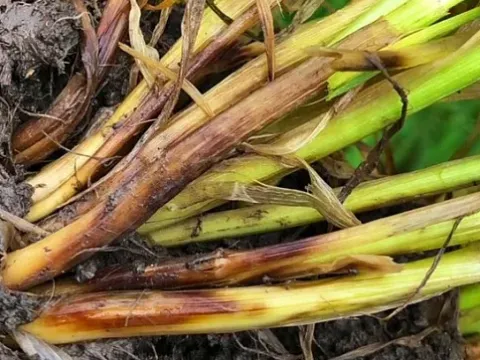
Beyond the heads, the pathogen infects the root system, causing decay that disrupts nutrient and water uptake throughout the plant's growth cycle.
A major concern is the production of mycotoxins, such as T-2 toxin, which significantly compromises the safety of the harvested grain for consumption.
The primary visual symptom of Fusarium head blight is the premature whitening of individual spikelets or the entire ear during the grain-filling stage.
In high-humidity conditions, a characteristic pink, orange, or white fungal mycelium appears on the spikelet glumes, indicating active sporulation.
Root rot symptoms include general plant stunting, yellowing of lower leaves, and brown lesions at the base of the stem or root nodes.
Seeds from infected heads are often shriveled, discolored, and lightweight, which directly correlates to a significant reduction in grain quality.
- Premature bleaching of ears.
- Pink or orange mold growth on heads.
- Root and crown rot symptoms.
- Shriveled and light-weight kernels.
Warm temperatures coupled with frequent rainfall during the flowering stage of cereals create the ideal environment for Fusarium infection.
High relative humidity levels (exceeding 75-80%) are critical for the germination of fungal spores on the delicate tissues of the cereal head.
Poor crop rotation practices, where cereal crops are planted in close succession, facilitate the buildup of pathogen inoculum in the soil.
Conservation tillage systems that leave significant amounts of crop residues on the soil surface provide a reservoir for the pathogen to overwinter.
Weather patterns that promote prolonged leaf and head wetness during the grain-filling period are significant drivers of disease outbreaks.
Fusarium infections lead to substantial yield losses due to poor grain filling, stunted growth, and death of productive tillers.
Grain quality is severely downgraded, often resulting in complete rejection of the harvest due to the presence of harmful mycotoxins.
Infected seeds exhibit reduced germination rates, making them unsuitable for use as sowing material, which propagates the cycle of infection.
Root rot leads to poor stand establishment, increasing the vulnerability of the crop to other environmental stressors and weed competition.
The cumulative impact of the disease results in significant economic losses for agricultural producers and risks to the food supply chain.
Implementing a diverse crop rotation is a primary defense, breaking the host cycle for Fusarium species that inhabit the soil.
Effective management of crop residues, including plowing or incorporation, helps accelerate decomposition and reduce the survival of fungal inoculum.
Treating seeds with appropriate fungicides is essential to protect young seedlings from early-season root rot and associated pathogen colonization.
Applying preventative fungicides to heads during the flowering period is recommended when weather forecasts indicate high infection risk.
Prioritizing the selection of resistant cultivars helps to mitigate disease pressure and ensures better crop resilience throughout the growing season.