
Fusarium head blight
Fusarium graminearum
The causative agent of the disease is the fungus Fusarium graminearum (along with other Fusarium species), which belongs to the imperfect fungi. It persists in the soil, on crop residues, and in infected seeds.
What the section contains
Fusarium head blight
The infection forms a complex pathogen profile that can survive across a wide range of temperatures. The fungus actively produces mycelium, conidia, and perithecia, ensuring its high resilience in field conditions.
The life cycle of the pathogen is closely tied to humidity levels. During the flowering stage of cereals, fungal spores are dispersed by wind and rain, landing on the anthers and spikelets of the plants.
Once it lands on the ear, the fungus germinates and begins to aggressively colonize the plant tissues. The mycelium penetrates the embryo and endosperm of the grain, disrupting normal development and maturation.
The fungus produces a wide range of dangerous secondary metabolites known as mycotoxins, which render the harvest unsuitable for human consumption or animal feed.
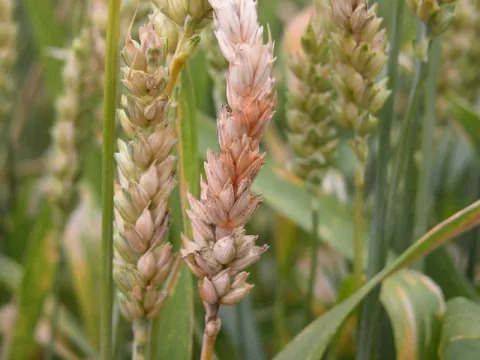
The first sign of the disease is the premature bleaching of the spikelets, which appears against the backdrop of still-green plant parts. Infected heads look like white patches among the healthy crop.
Under high humidity, a characteristic fungal growth can be observed on the surface of the head, usually showing a pink or orange hue. This layer consists of masses of conidia and mycelium.
Internal tissues of the head gradually decay, and the grains become shriveled, wrinkled, and often lose their natural luster. Dark spots or a continuous pinkish layer may appear on the surface of the grains.
Infection can cover either a portion of the head (partial whitehead) or the entire head if the pathogen has entered through the stem base or the rachis.
In the later stages, tiny dark dots — the fruiting bodies of the fungus (perithecia) — can be found on the glumes, which ensures the further spread of the infection.
The key factor in the development of Fusarium head blight is high air humidity (over 75-80%) and moderately warm temperatures (20-25°C) during the flowering period.
Frequent rainfall during the heading and flowering stages creates ideal conditions for spore production and dispersal. In such years, the risk of massive disease outbreaks increases significantly.
Poor agricultural practices, particularly the lack of crop rotation, significantly increase the pool of inoculum in the soil. It is especially dangerous to plant cereals after stubble-heavy predecessors like maize or wheat.
Plants damaged by pests (such as bugs or thrips) become more vulnerable to pathogen penetration, as the insects create entry points for the fungal mycelium.
Inadequate or imbalanced mineral nutrition, particularly excess nitrogen coupled with potassium and phosphorus deficiency, can also reduce the overall resistance of the plants to Fusarium.
Fusarium head blight causes massive economic losses, leading to significant yield reductions (up to 30-50% or more in favorable years for the disease).
The disease causes not only grain weight loss but also a sharp deterioration in technological and seeding qualities. Infected grain exhibits low germination rates and seedling vigor.
A major danger lies in the accumulation of mycotoxins like deoxynivalenol (DON) and zearalenone, which makes the harvest toxic to humans and livestock.
Affected produce cannot be exported or processed into high-quality flour because mycotoxin levels are strictly regulated by international sanitary standards.
Infected grain also shows poor baking quality, as the fungal enzymes break down gluten, leading to low-quality bread production.
The foundation of protection is the use of resistant cultivars, which possess genetically determined resistance to infection during the flowering stage.
Strict adherence to crop rotation, which excludes planting cereals after susceptible crops, is a mandatory agricultural measure to reduce the infectious background.
High-quality soil tillage, including deep incorporation of crop residues, promotes their rapid decomposition and the destruction of the mycelium overwintering on the stubble.
The application of systemic fungicides at the onset of flowering (heading stage) is the most effective chemical method. Triazole-based products are effective in suppressing fungal development in the head.
- Cleaning and seed treatment with high-quality fungicides.
- Applying optimal doses of fertilizers to strengthen plant immunity.
- Prompt harvesting to avoid delays in the field.
- Timely grain drying after harvest to prevent mold growth during storage.