
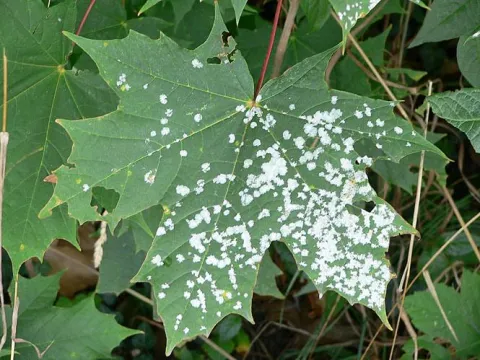
Maple powdery mildew
Erysiphe macrospora
The disease is caused by the fungus Erysiphe macrospora, which is a member of the Erysiphaceae family and acts as an obligate parasite.
What the section contains
Maple powdery mildew
This pathogen specifically colonizes maple species, drawing nutrients directly from the epidermal cells of the leaves through specialized structures called haustoria.
It is classified as a powdery mildew, characterized by its superficial growth habit on the aerial parts of the host plant.
The fungus produces a vast quantity of conidia during the growing season, which are easily wind-dispersed to infect healthy leaves nearby.
Overwintering occurs primarily through the production of chasmothecia (formerly called cleistothecia), which reside on leaf litter until the next spring.
The primary symptom is the presence of white to grayish, powdery fungal mycelium covering the leaf surface, which looks like flour dusting.
In early stages, the infection appears as irregular, discrete spots that eventually merge to cover the entire leaf, stem, or petiole.
Affected leaves may become distorted, curled, or stunted as the fungus disrupts normal physiological functions of the plant tissue.
As the season progresses, the white growth may darken, and tiny black, pepper-like dots (fruiting bodies) become visible within the mycelial mats.
- White powdery patches on leaves.
- Deformation and curling of foliage.
- Premature yellowing or browning.
- Reduced vigor of young shoots.
- Early leaf abscission in severe cases.
The pathogen thrives in warm temperatures combined with high relative humidity, which promotes rapid spore germination and mycelial growth.
Poor air circulation within the tree canopy, often caused by improper spacing or dense foliage, creates a stagnant environment favorable for infection.
Shaded locations with limited sunlight are generally more susceptible to severe powdery mildew outbreaks compared to open, sunny areas.
Fluctuating day and night temperatures, common in late summer, can trigger the transition to the sexual stage of the fungus.
Plants under water stress or those experiencing nutritional imbalances are notably less resistant to the invasion of Erysiphe macrospora.
Powdery mildew primarily harms the host by inhibiting photosynthesis, as the mycelial layer acts as a physical barrier to sunlight.
This leads to a significant decrease in carbohydrate production, which weakens the overall structural integrity and winter hardiness of the maple tree.
Severe infestations result in early leaf drop, forcing the tree to expend energy reserves prematurely, which hinders growth the following year.
For young saplings and nursery stock, the disease can be devastating, leading to stunted shoot growth and reduced marketability of the plants.
While rarely fatal to large, mature trees, chronic infection weakens the host, making it susceptible to secondary pests and environmental stressors.
Sanitation is the most critical control measure; removing and destroying infected fallen leaves helps break the disease cycle and reduces inoculum load.
Pruning the canopy to improve light penetration and air movement is an effective cultural practice to minimize moisture build-up.
When necessary, fungicides containing sulfur, potassium bicarbonate, or systemic triazoles can be used to treat active infections.
Avoid excessive use of nitrogen fertilizers, as they encourage rapid succulent growth that is highly preferred by the fungus.
Monitor trees regularly and implement integrated pest management strategies to keep the pathogen population below a damaging threshold.