
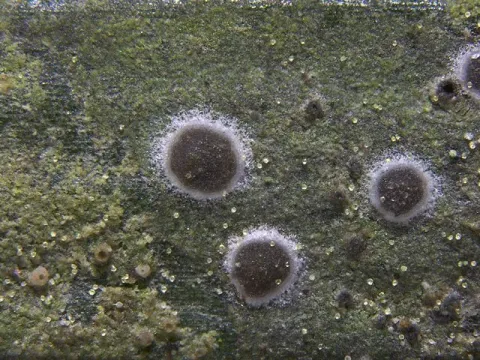
Ectolechiaceae lichens
Ectolechiaceae
Ectolechiaceae is a family of lichens, which are composite organisms consisting of a fungus and an alga living in a symbiotic relationship, not as a disease pathogen.
What the section contains
Ectolechiaceae lichens
These organisms are classified as epiphytes, meaning they use the bark of trees primarily as a physical substrate for anchoring and growth.
They do not invade the living tissues of the host plant and do not derive nutrients from the tree sap, thus they do not technically cause plant disease.
Biologically, their body (thallus) is structured to capture atmospheric moisture and minerals, which is sufficient for their survival without affecting the tree's metabolism.
Their presence is typically a secondary indicator of the environmental conditions or the tree's growth rate rather than an active pathogenic infection.
The most common sign is the development of crusty, scale-like, or patch-like growths on the surface of tree branches and trunks, varying in color.
These growths may appear as green, gray, or yellowish coatings that become more distinct when wet, sometimes forming intricate patterns on the bark.
Unlike parasitic infections that cause soft rot or deep cracks, the bark underneath the lichen remains firm, healthy, and free of necrotic lesions.
During dry spells, the lichen thallus may turn brittle and flake off, revealing the natural texture of the underlying bark underneath.
The visual appearance of a tree with heavy lichen cover is often described as "weathered" or "old," which does not necessarily imply a lack of vitality.
High humidity and consistent moisture levels are the most critical factors for the successful colonization and growth of Ectolechiaceae lichens.
Poor airflow within the tree canopy, often caused by lack of pruning or dense foliage, creates a stagnant microclimate that supports lichen development.
Trees that grow slowly or have reached a significant age tend to have bark that remains undisturbed for longer periods, providing a perfect home for epiphytes.
Low-light environments within deep orchards or forests further contribute to the proliferation of these organisms on woody surfaces.
A lack of regular maintenance, such as bark cleaning or thinning of the canopy, naturally allows these organisms to accumulate over several years.
While not a disease, a thick layer of lichen can harbor pests, such as scale insects or mites, that find shelter in the crevices between the bark and the lichen.
In extreme cases, excessive coverage can slightly hinder the bark's ability to "breathe," though this impact on the tree's overall physiology is usually minimal.
The primary concern for an agronomist is that dense lichen patches can hide early warning signs of genuine diseases, such as fungal cankers or insect borers.
Persistent moisture held by the lichen against the bark can sometimes lead to localized softening, which might facilitate secondary fungal infections.
Significant lichen growth on young, fast-growing trees is often a warning sign that the tree is not growing vigorously enough or lacks proper care.
Regular canopy management, including pruning, is the most effective way to improve airflow and reduce the humidity levels that favor lichen growth.
Mechanical cleaning of the trunk and main branches using a stiff-bristled brush during wet weather can physically remove the lichen thallus effectively.
Applying a lime wash (whitewashing) to the lower trunk and main branches acts as a natural deterrent, preventing new lichen spores from taking root.
Copper-based fungicides, applied during the dormant season, are effective in controlling lichen populations while simultaneously treating other fungal threats.
Encouraging tree vigor through proper fertilization and watering helps the tree maintain a healthy, active bark shedding process that prevents lichen colonization.