
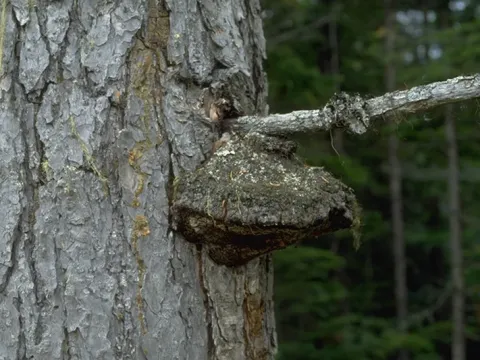
Echinodontium
Echinodontium
Echinodontium is a genus of wood-decay fungi, with Echinodontium tinctorium being the most notable species, primarily affecting coniferous trees. It is a persistent pathogen that thrives within the heartwood of the tree.
What the section contains
Echinodontium
The fungus enters the tree through wounds, such as broken branches, frost cracks, or animal damage. Once inside, the mycelium colonizes the wood, gradually decomposing the lignin and cellulose that provide structural integrity.
The fruiting bodies are hard, hoof-shaped, and usually grow in rows on the trunk. The underside is characterized by a unique, spiny surface that produces vast quantities of spores, which are essential for the fungus to spread to new hosts.
This pathogen is highly specialized and often lives for decades within a single tree, slowly consuming the internal structure without causing immediate death, which makes it a subtle but destructive force.
The biology of the fungus allows it to withstand various environmental stresses, enabling it to remain active even under conditions that might inhibit other, less resilient forest fungi.
The most visible sign of an Echinodontium infection is the emergence of large, perennial fruiting bodies (conks) on the tree trunk. These are usually found in clusters near previous injury points.
Internally, the wood undergoes a significant transformation. The heartwood changes color, often becoming yellow, reddish-brown, or white, as the fungus breaks down the internal wood cells.
Advanced stages of decay result in the wood losing its structural strength. The trunk becomes hollow or soft, which significantly increases the likelihood of the tree breaking under stress, such as strong winds or heavy snow.
Bark cracks and localized depressions on the stem often indicate internal decay. In some cases, the thinning of the crown or premature needle drop can suggest that the tree's vascular system is being impacted.
Instrumental checks, such as using an increment borer to extract a wood core, often reveal the presence of advanced rot long before the fruiting bodies become visible on the exterior.
Echinodontium is most commonly associated with old-growth or mature forests. Older trees have accumulated more physical injuries over time, providing the necessary entry points for fungal spores.
High humidity and cool, damp climates favor the germination of spores and the subsequent colonization of the tree's interior. This is why the fungus is particularly prevalent in dense, unmanaged forest stands.
Poor silvicultural practices, such as excessive mechanical injury during logging, significantly increase the risk of infection. Open wounds on a trunk are essentially open doors for this pathogen.
The density of the stand plays a critical role in the spread of the disease. Overcrowded forests with limited airflow create a microclimate that promotes the survival and dispersal of fungal spores.
Stress factors, including prolonged droughts or insect infestations, can weaken a tree's natural defense mechanisms, making it significantly more susceptible to successful colonization by the fungus.
The economic impact of Echinodontium is severe, as it renders high-quality timber useless for commercial purposes. Once a tree is internally decayed, its value as lumber drops to nearly zero.
The fungus causes massive loss of forest biomass, which leads to habitat degradation. By killing trees slowly, it prevents them from reaching their full potential as carbon sinks and forest stabilizers.
Trees infected with this fungus pose a physical safety hazard. Their weakened stems can collapse unexpectedly, creating significant risks for forestry workers and the public in recreational forest areas.
The persistence of the pathogen in a stand leads to reduced growth rates for the entire forest, as affected trees struggle to maintain vital functions with reduced sapwood and heartwood integrity.
Managing an outbreak requires significant financial investment, including the removal of infected trees and the potential for large-scale timber losses, which disrupts long-term forest management plans.
The most effective strategy for controlling Echinodontium is the sanitation of the forest stand. Identifying and removing infected trees helps reduce the spore load and limits further transmission.
Careful forest management is essential to prevent injury to healthy trees. Limiting mechanical damage during thinning or harvesting operations is a primary preventative measure against fungal entry.
Regular forest pathology monitoring and surveys are vital. Early detection allows for the localized removal of diseased trees before they can create a widespread source of infection.
Silvicultural strategies that promote healthy, vigorous tree growth help boost the tree's innate resistance to fungal pathogens. Thinning stands to improve airflow can also discourage spore germination.
In cases of severe infestation, replanting with resistant or non-host tree species may be necessary to break the cycle of infection and restore the health and productivity of the forest ecosystem.