
Dilophospora disease
Dilophospora alopecuri
The causative agent of the disease is the fungus Dilophospora alopecuri, a member of the class Coelomycetes. This pathogen is known for its obligate association with the wheat seed gall nematode Anguina tritici.
What the section contains
Dilophospora disease
The fungus lacks the ability to penetrate healthy plant tissue independently. It relies entirely on nematode larvae, which act as vectors, transporting fungal conidia to the plant's growing point.
Inside the infected tissue, the fungus develops pycnidia, which are dark, flask-shaped structures containing spores. These conidia are equipped with specific appendages that facilitate attachment to the nematode cuticle.
The life cycle of the pathogen is highly synchronized with the developmental stages of host cereal crops, ensuring survival through the winter and successful reinfection in the spring.
Infection persists in the environment within plant debris, soil, or as contaminants in seed lots that contain galls from the previous harvest.
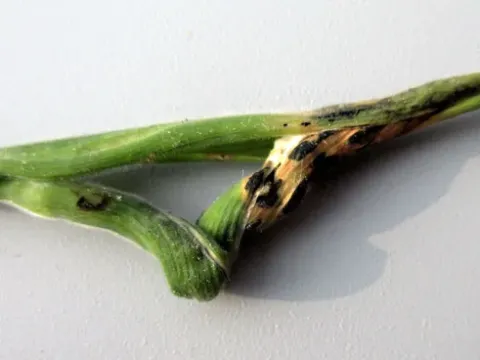
The hallmark symptom of this disease is the characteristic twisting and distortion of the upper leaves, which often appear to be glued together in a spiral shape.
Black, minute pycnidia are clearly visible on the infected leaf blades and distorted floral parts. These small spots can coalesce, covering significant areas of the plant surface.
Heads (ears) of affected plants are usually malformed or stunted and often fail to emerge properly from the leaf sheath, leading to a "twisted" or "hooked" appearance.
Plant tissues affected by the fungus become chlorotic, wither, and eventually die prematurely, which severely disrupts the plant's ability to photosynthesize.
Because these symptoms can closely mimic severe nematode damage, laboratory identification involving microscopic examination of pycnidia is required for an accurate diagnosis.
The development of the disease is favored by prolonged periods of cool, wet weather during the early stages of cereal crop growth in the spring.
High relative humidity and surface moisture on plants are essential for the migration of nematode larvae, which carry the fungal spores from the soil up the stem.
Optimal temperature ranges for spore germination and successful infection typically fall between 10 and 15 degrees Celsius.
Continuous cropping of cereals creates favorable conditions for the buildup of both the nematode population and the fungal pathogen within the field.
The presence of nematode galls in the seed supply is the primary factor responsible for the introduction and spread of the disease into new production areas.
The primary damage caused by Dilophospora disease is a substantial reduction in yield due to inhibited growth and the failure of plants to produce viable grain.
Affected plants often produce empty or shriveled heads, leading to significant economic losses for the farmer in terms of both grain quantity and quality.
The spread of contaminated seed leads to poor crop stands in subsequent years, effectively turning the farm's own production into a source of infestation.
The stress caused by the fungus and its nematode partner makes the crop more susceptible to secondary pathogens and abiotic environmental pressures.
In severe infestation cases, the disease can render significant portions of a field unharvestable, requiring long-term soil management to reduce the inoculum level.
The most critical control measure is the use of high-quality, certified seeds that are free from nematode galls and fungal contaminants.
Implementing a diverse crop rotation strategy, which avoids hosting cereal crops for several seasons, helps break the nematode life cycle and reduces inoculum.
Deep plowing and proper management of crop residues help bury the infected plant material, reducing the likelihood of survival for the pathogen's pycnidia.
Utilizing modern seed cleaning equipment is essential to remove lightweight galls and debris from the harvest before it is used for sowing.
Integrated weed control is also necessary, as many wild grasses can act as alternate hosts for the nematode vector, maintaining the disease in the field.