
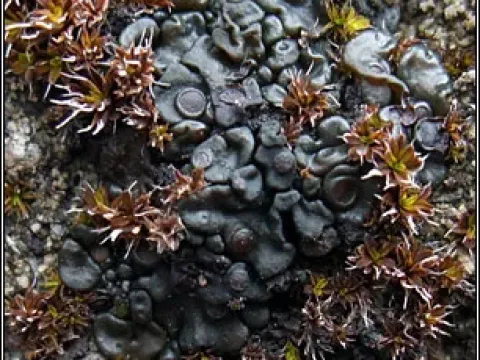
Collema tenax
Collema tenax
Collema tenax is a species of gelatinous lichen that is not a plant pathogen. It lives on the soil surface in a symbiotic relationship between fungi and cyanobacteria.
What the section contains
Collema tenax
It does not infect or damage cultivated plants, as it lacks specialized organs to penetrate host tissues. It simply uses the soil as a substrate for its growth.
The organism is biologically distinct, capable of nitrogen fixation, which makes it a natural component of some soil ecosystems.
In agricultural settings, its appearance is often mistaken for a fungal disease or a mold problem, leading to unnecessary chemical treatments.
It is important to treat it as an indicator of soil conditions rather than a plant disease that requires traditional pest control.
The primary sign of its presence is the appearance of dark olive, brown, or black patches on the soil surface.
In wet conditions, these patches swell up and take on a soft, jelly-like, or mucilaginous texture, which is a hallmark of this species.
When the soil dries out, the lichen turns into a brittle, dark crust that can be easily crumbled by touch.
It usually colonizes open, undisturbed, or compacted soil where there is little competition from grass or other ground-covering plants.
There are no associated lesions or decay on any nearby plants, which serves as a key diagnostic feature distinguishing it from pathogens.
Collema tenax thrives in areas with high moisture content and good sunlight, which are necessary for the photosynthetic cyanobacteria.
It is frequently found on calcareous or alkaline soils that are periodically waterlogged or suffer from poor drainage.
Compacted ground provides an ideal surface for the spores to land and establish, as there is a lack of competing vegetation.
The lichen is highly resilient to cycles of wet and dry weather, allowing it to survive in difficult environments.
Open landscapes, footpaths, and thin lawns are the most common habitats for this species, where soil cover is insufficient.
This lichen causes no direct harm to crops or garden plants as it does not parasite on them or compete for nutrients in the root zone.
Its main impact is the formation of a surface crust that can inhibit water infiltration and gas exchange, potentially stressing sensitive seeds.
It competes for physical space, which may prevent the establishment of a dense lawn or ground cover vegetation.
The presence of Collema tenax is essentially a symptom of suboptimal soil health, poor drainage, or excessive compaction.
While not a disease, it can affect the aesthetic quality of lawns and landscaped areas due to the development of dark, slimy patches.
Management should focus on improving soil conditions and enhancing the density of desired plants to crowd out the lichen.
Aerating the soil is the most effective way to address compaction and improve drainage, which creates an environment unsuitable for lichen growth.
Maintaining a healthy, dense turf or ground cover is the best biological control method to prevent new patches from establishing.
- Improve soil drainage to prevent water accumulation.
- Aerate the soil to break up compaction and improve oxygenation.
- Overseed thin areas to ensure full plant coverage.
Chemical control via fungicides is generally ineffective and not recommended, as the lichen is not a plant pathogen and will return if soil conditions remain poor.