
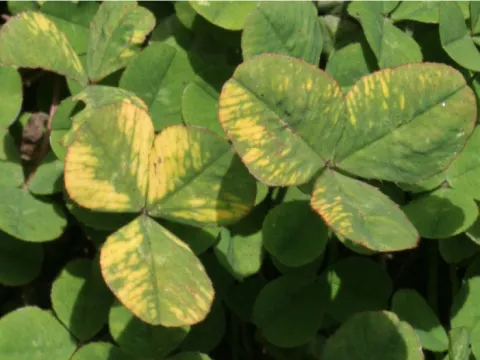
Clover yellow vein
Clover yellow
The Clover yellow vein virus (CYMV) is a member of the Potyvirus genus. It is a major viral pathogen known for causing significant mosaic diseases in various legume species.
What the section contains
Clover yellow vein
This virus has a wide host range, primarily infecting legumes. Among economically important crops, common bean (Phaseolus vulgaris), peas, clover, and lupins are frequently affected.
The virus persists in perennial legumes, which act as primary reservoirs, allowing the pathogen to survive during winter and spread when conditions become favorable.
Transmission occurs primarily in a non-persistent manner by aphid vectors, which acquire the virus while feeding on infected plants and transmit it to healthy ones during subsequent feeding.
Mechanical transmission is also possible through contaminated agricultural machinery or plant-to-plant contact, facilitating the spread of the virus within the field.
The most common symptoms include a distinct mosaic pattern characterized by irregular yellow and light-green patches on the leaves, interfering with the photosynthetic area.
In common beans, leaves often show significant distortion, wrinkling, and leaf-edge curling. This deformation is a hallmark sign of severe viral infection in susceptible cultivars.
Infected plants typically exhibit stunted growth. Shorter internodes and reduced plant height become apparent as the virus disrupts normal physiological development.
In some cases, the virus leads to reduced flowering and smaller, deformed pods, which directly impacts the overall harvest quality and total yield of the bean crop.
- Mosaic mottling on leaves.
- Leaf distortion and curling.
- Stunted plant development.
- Reduction in pod size and number.
Aphids are the primary vector for spreading CYMV. A rapid increase in aphid populations during the growing season correlates strongly with the prevalence of the virus.
Environmental factors, such as warm and dry weather, promote the activity of aphid populations and accelerate their migration between host plants.
Proximity to perennial clover fields or weeds that host the virus significantly increases the probability of early-season infection in commercial bean crops.
Inadequate field management, including failure to control weeds and improper crop rotation, creates favorable conditions for the survival and spread of the pathogen.
Moisture levels and plant density can influence the efficiency of mechanical transmission, as crowded plants are more likely to have contact during wind or maintenance.
Clover yellow vein virus causes substantial economic losses by reducing both the yield and the market value of legume crops. Heavily infected beans often fail to meet commercial standards.
Viral infection drains the plant of essential nutrients, leading to poor growth and a weakened immune system that makes the crop more susceptible to secondary stressors.
The reduction in photosynthetic capacity limits biomass accumulation, resulting in fewer and smaller seeds, which affects the potential for future planting material quality.
Management costs increase due to the necessity of applying insecticides to control vectors, adding to the financial burden of managing the viral disease.
In severe cases, entire sections of a crop can be rendered non-productive, potentially necessitating the destruction of the planting to prevent further spread.
Spatial isolation between commercial bean fields and perennial legume sources is a critical strategy to limit the initial introduction of the virus into the crop.
Effective aphid control using systemic insecticides can significantly reduce the rate of virus transmission within a field during the critical early stages of crop development.
Sanitation practices, including the aggressive removal of weed reservoirs around fields and irrigation ditches, help eliminate potential sources of infection.
Selecting and planting resistant or tolerant bean varieties is the most sustainable and efficient approach for managing Clover yellow vein in agricultural systems.
Field scouting and the removal of early-infected plants can serve as an effective means of limiting the size of the infection hotspots throughout the growing season.