
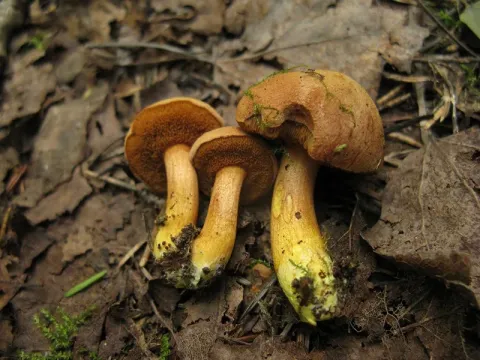
Peppery Bolete
Chalciporus piperatus
The Peppery Bolete (Chalciporus piperatus) is a basidiomycete fungus belonging to the Boletaceae family. It occupies a unique niche, often functioning as a mycoparasite that derives nutrients from the mycelium of other mycorrhizal fungi.
What the section contains
Peppery Bolete
The pathogen agent is its vegetative mycelium, which invades the hyphae of host fungi. It is crucial to note that this is not a plant pathogen; it does not infect the roots or tissues of agricultural crops or forest trees.
Morphologically, the fungus is characterized by a reddish-brown tube layer and a flesh that possesses a distinct, pungent peppery taste. This unique chemical profile is its hallmark identification feature.
Its biological cycle is inextricably linked to the root systems of coniferous and deciduous trees, where it competes with other fungal species. It does not damage the host tree directly but rather affects the fungal community structure.
The interaction between the Peppery Bolete and its fungal hosts is a classic example of fungal antagonism. It utilizes specific bioactive compounds to inhibit the growth of surrounding fungi, ensuring its own success in the soil environment.
The development of the Peppery Bolete is highly dependent on environmental conditions, specifically high humidity and moderate temperatures. It is frequently observed in moist forest habitats during late summer and autumn.
It prefers acidic soils characteristic of pine and spruce forests. The presence of established mycorrhizal fungal networks is a primary requirement for the fungus to fruit and complete its lifecycle.
Dispersal is achieved through spores carried by wind currents. These spores require specific environmental moisture to germinate and establish a colony in the litter layer of the forest floor.
Temperature ranges between 15°C and 22°C are optimal for growth. Excessive drought leads to the rapid desiccation of the fruiting bodies, although the subsurface mycelium remains dormant and protected.
Anthropogenic impacts, such as soil compaction or drainage of forest areas, significantly disrupt the fungal balance and can lead to the local decline of this species.
The Peppery Bolete poses no threat to agriculture. It is not an infectious agent for crops and does not cause any diseases in vegetables, fruits, or cereals grown on a commercial scale.
Within forest ecosystems, its influence is considered minimal. While it acts as a competitor to beneficial mycorrhizal fungi, its presence does not typically lead to significant damage to forest health or timber production.
From an economic standpoint, the mushroom is of little value. Due to its intense peppery flavor, it is generally considered inedible in large quantities and is ignored by foragers, causing no harm to the environment.
No control measures are required for this fungus. It is a natural component of forest mycology, and its presence is essentially irrelevant to farmers and forestry managers alike.
Management strategies do not exist because the species does not constitute a pest or a disease problem. Observations of this fungus are primarily of interest to mycologists studying community dynamics and fungal competition.