
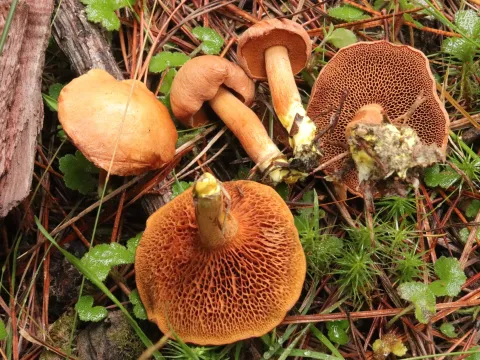
Peppery bolete
Chalciporus amarellus
Important clarification: the scientific name Chalciporus piperatus (synonym Chalciporus amarellus) refers to a species of mushroom in the Boletaceae family, not a pathogen of agricultural crops.
What the section contains
Peppery bolete
This organism is a mycorrhizal fungus that forms symbiotic relationships with the root systems of various trees, primarily coniferous and deciduous species.
Its life cycle is closely linked to the forest soil ecosystem, where the mycelium interweaves with fine tree roots to facilitate the exchange of nutrients.
Unlike phytopathogens, Chalciporus piperatus is not a parasite or an infectious agent that attacks plant tissues or causes their degradation.
Its biological activity is purely mutualistic, contributing to the healthy growth of trees in natural forest environments.
The fruit bodies of this mushroom are characterized by a specific yellow-brown or coppery cap color, which can appear matte and velvety in dry conditions.
The hymenophore, located under the cap, features a tubular structure and is distinguished by a distinct rusty-brown or yellowish-ochre color.
When damaged or cut, the flesh of the mushroom may show slight color changes or retain its natural hue, possessing a characteristic pungent, peppery taste.
In the field, the mushroom is often found singly or in small groups, hidden among forest litter, moss, or pine needles near tree trunks.
A key sign is the absence of typical plant disease symptoms, such as necrosis, leaf spots, chlorosis, or wilting of shoots on the host plant.
Active development of peppery bolete fruit bodies requires high air humidity and moderate temperatures, typical of the summer-autumn season.
The fungus prefers acidic soils rich in organic matter, which is frequently observed in pine or mixed forests dominated by coniferous species.
Optimal conditions for mycorrhiza formation are established when the soil temperature remains stable in the range of 15 to 22 degrees Celsius.
Excessive soil compaction or disruption of the forest microclimate can negatively affect the fruiting of this mushroom species.
Spore dispersal occurs primarily via air currents, allowing the species to efficiently colonize suitable forest ecosystems over significant distances.
This object does not harm agricultural crops because it lacks the enzymatic apparatus necessary to destroy the cell walls of cultivated plants.
The economic significance of the fungus is limited to its role in maintaining forest ecosystems, where it promotes tree health through mycorrhizal associations.
In an agronomic context, this species acts as an indicator of healthy forest soils but poses no threat to fields or gardens.
From a food safety perspective, due to its pungent peppery taste, this mushroom is rarely used for consumption, although it is not poisonous or toxic to humans.
Control measures against this mushroom in forests or gardens are unnecessary, as it performs an ecological function as a natural component of the biocenosis.
Since the fungus is not a pathogen, any protective measures, including fungicide treatments or agricultural control methods, are not required.
If these mushrooms are found on a plot in a forest zone or near windbreaks, they should not be removed, as they contribute to better nutrient uptake for trees.
To avoid confusion with dangerous pathogens, it is important to conduct precise diagnosis based on the morphological characteristics of the fruit bodies.
If there are doubts regarding the health of trees, it is recommended to focus on specific bark and root diseases that are unrelated to Chalciporus.
An ecologically balanced approach involves respectful management of mycorrhizal fungi as a vital part of the forest community.