
Ceratomycetaceae
Ceratomycetaceae
The Ceratomycetaceae family belongs to the order Laboulbeniales, which are obligate ectoparasitic fungi specifically adapted to living on insects.
What the section contains
Ceratomycetaceae
These fungi do not form a typical mycelium that penetrates host tissues; instead, they develop specialized structures called thalli on the surface of the insect cuticle.
They are highly host-specific, often evolving alongside particular groups of insects and relying on host contact for the transmission of their ascospores.
The life cycle is exclusively tied to the host's behavior, with spores being transferred during grooming, mating, or other forms of physical interaction.
They are not plant pathogens and have no impact on crop tissue, making them ecologically distinct from typical agricultural fungi.
The primary symptom is the appearance of small, dark, and often elongated structures known as perithecia on the exoskeleton of the host insect.
These fungal growths are commonly found on the legs, elytra, or abdomen, depending on the specific host and its behavioral habits.
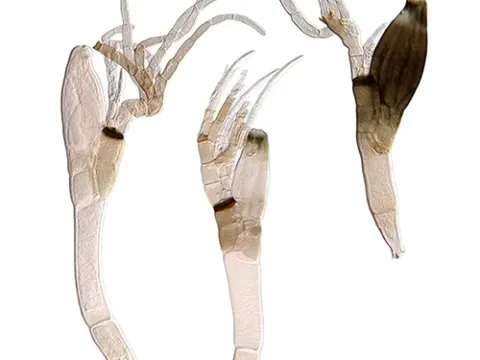
Under a microscope, these structures exhibit a distinct morphology, characterized by a basal cell that anchors the fungus to the insect's chitinous surface.
Infestation might result in reduced vigor in the insect, although in many cases, the host remains active while carrying the fungal load.
In dense insect populations, the presence of these fungi can be observed as a localized infection spreading through physical contact between individuals.
Development is heavily dependent on high humidity and the presence of host populations that facilitate the transfer of spores.
The temperature must remain within the range suitable for the host insect, as the fungus is entirely dependent on the living organism for growth.
High host density is a crucial factor for the persistence and transmission of the fungus within an area.
The absence of synthetic chemical stressors, such as broad-spectrum fungicides or insecticides, supports the stability of fungal populations.
Specific environmental niches that favor the activity of the host insects are essentially the same niches that favor the growth of Ceratomycetaceae.
The harm caused by these fungi is largely negligible for agricultural crops, as they do not feed on plant tissue or cause diseases in plants.
In an agricultural context, they serve as natural regulators of insect populations, potentially reducing the number of pests naturally.
There is virtually no economic damage associated with their presence on insects, as they are part of the natural biological complexity of the ecosystem.
Rarely, they might affect beneficial insects like pollinators, but this rarely reaches a level that impacts crop yield or agricultural performance.
They are considered beneficial or neutral agents within an Integrated Pest Management (IPM) framework.
No control measures are required for Ceratomycetaceae, as they do not pose a threat to plant health or agricultural productivity.
To preserve natural biological control agents, it is advisable to maintain sustainable agricultural practices that avoid unnecessary chemical applications.
Encouraging biodiversity on farmland ensures the stability of natural entomopathogenic fungal populations, contributing to long-term pest management.
Monitoring the prevalence of such fungi can provide insights into the health of local insect populations and the efficacy of natural population control.
No specific management is needed; rather, a "do no harm" approach to existing natural regulatory processes is recommended.