
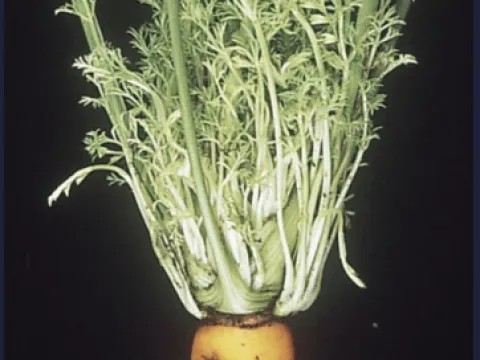
Aster yellows
Aster yellows
The causative agent of the disease is the Aster yellows phytoplasma, a specialized intracellular parasite that colonizes the plant phloem. These are gram-negative prokaryotes that lack a cell wall and rely entirely on the host's vascular system.
What the section contains
Aster yellows
The disease is classified as a systemic phytoplasmosis. It cannot survive independently in the environment and relies exclusively on insect vectors for transmission between host plants.
The primary vectors are leafhoppers (specifically Macrosteles quadrilineatus). After feeding on an infected plant, the leafhopper undergoes a latency period before becoming capable of transmitting the pathogen for the remainder of its life.
The host range is broad, affecting both ornamentals and food crops. Notable susceptible species include onions, garlic, celery, watermelons, sunflowers, Jerusalem artichokes, winter barley, and flax.
The pathogen overwinters in perennial weeds or within the bodies of surviving leafhoppers. As temperatures rise in spring, the vectors migrate from reservoir hosts to commercial agricultural fields.
The initial symptom is chlorosis, a yellowing of the foliage that typically begins at the tips of young leaves. As the disease progresses, the chlorotic pattern spreads throughout the entire plant.
A classic sign is the proliferation of axillary shoots, giving the plant a stunted, bushy appearance known as "witches' broom." Internodes become significantly shortened, causing leaves to crowd into a rosette.
In flowering plants, virescence is common, where petals transform into green, leaf-like structures. Floral development is often disrupted, leading to deformed or sterile blossoms.
In onions and garlic, the disease causes the twisting of stalks and the failure of bulbs to mature properly. Root crops like celery often show reddening or purpling of leaves and systemic decline.
Internally, the disease causes phloem necrosis, which obstructs the translocation of sugars and nutrients. This vascular blockage leads to eventual wilting and total collapse of the plant's physiological functions.
The severity of Aster yellows outbreaks is directly correlated with leafhopper population dynamics. Warm, dry weather conditions promote rapid multiplication and migration of these vectors.
The presence of unmanaged weedy areas adjacent to fields is a major risk factor, as these weeds act as reservoirs for the phytoplasma throughout the growing season.
Migration of vectors into crops typically peaks in mid-summer, coinciding with the rapid growth phase of many vegetable crops, which makes them highly vulnerable during this time.
Improper crop rotation can exacerbate the issue if susceptible crops are planted repeatedly in fields where the pathogen was detected in previous seasons.
Environmental factors that favor vector survival during the winter, such as mild winters or dense ground cover in nearby fallow lands, increase the early-season infection pressure.
The primary economic impact of Aster yellows is the drastic reduction in produce quality. Infected crops become unmarketable due to discoloration, deformation, and stunted growth.
For cereal crops and fiber crops like flax, the disease causes shriveled seeds and poor-quality fibers, leading to significant yield losses that can reach up to 80% in severe cases.
Because the disease is systemic, there is no chemical cure for an infected plant. Once a plant is symptomatic, it serves as a persistent source of infection for the rest of the field.
For crops intended for long-term storage, such as garlic and onions, infected produce often rots prematurely in storage due to altered metabolic processes.
The inability to eradicate the pathogen once established in a region makes Aster yellows a high-priority challenge for growers, necessitating integrated pest management approaches.
The most effective management strategy is the control of leafhopper populations. The application of systemic insecticides during the early stages of crop development can reduce vector numbers and secondary spread.
Spatial isolation is a crucial preventive measure. Planting susceptible crops as far as possible from perennial weeds and untreated grasslands minimizes the risk of vector migration.
Cultural practices, specifically rigorous weed control, are essential to remove reservoir hosts from around the field perimeter, effectively lowering the overall inoculum pressure.
For vegetatively propagated crops, the use of virus-indexed, certified disease-free planting material is the only way to prevent the introduction of the pathogen into new areas.
- Using yellow sticky traps to monitor leafhopper arrival and density
- Roguing (removing and destroying) infected plants immediately upon symptom detection
- Implementing crop rotation with non-host species to break the disease cycle