
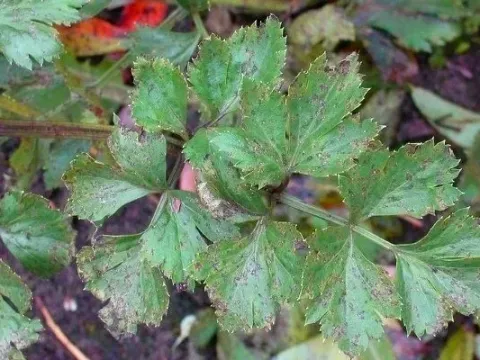
Parsley leaf blight
Alternaria petroselini
The disease is caused by the fungus Alternaria petroselini, an asexual pathogen belonging to the hyphomycete group. It is specifically adapted to infect plants of the Apiaceae family.
What the section contains
Parsley leaf blight
The pathogen survives in crop debris and contaminated soil for extended periods. It can also be transmitted via infected seeds, making high-quality, disease-free seed selection critical.
The life cycle involves the production of conidia (spores) on conidiophores. These spores are easily dispersed by wind currents, splashing water, and human activities within the garden.
As a parasitic fungus, it extracts nutrients from host tissues, leading to cell death. In the absence of a host, it can survive as a saprophyte on decaying plant material.
Its biological resilience allows the fungus to remain dormant during adverse conditions and reactivate immediately when temperature and moisture levels become favorable for growth.
Initial symptoms appear as small, dark brown spots on the leaves. As the infection progresses, these spots expand, often showing a concentric circular pattern known as target spots.
The centers of the spots may turn lighter brown or gray, while the edges remain dark. Under high humidity, a characteristic olive-black velvet-like fungal growth may appear on the lesions.
The infection frequently spreads to the petioles and stems, causing them to collapse. In severe cases, the entire leaf or the whole plant may wither and die prematurely.
If the infection occurs early in the development of the plant, seedlings can show signs of damping-off or stunting, leading to significant gaps in the crop rows.
Visual identification is usually confirmed by the presence of the dark, velvety spores on the necrotic tissues, especially visible on the undersides of the leaves under damp conditions.
The primary driver for disease development is high relative humidity, typically exceeding 70-80%. Frequent rain and morning dew create the perfect environment for spore germination.
Temperatures ranging from 20 to 25 degrees Celsius are optimal for the rapid colonization of host tissues. In these conditions, the incubation period is significantly reduced.
Dense planting practices restrict airflow, creating a humid microclimate around the foliage. This increases the susceptibility of the crop to fungal colonization.
Overhead irrigation, especially if performed in the late evening, allows water to sit on the leaves for too long. This creates the necessary water film for fungal spores to infect the plant.
Plants weakened by poor soil structure, waterlogging, or nutritional deficiencies are less able to defend themselves against the rapid penetration of fungal hyphae.
The primary impact of parsley leaf blight is the loss of commercial quality. Infected leaves are unsightly and not suitable for fresh market sales or culinary use.
The disease reduces the photosynthetic capacity of the plants, leading to stunted growth and lower total yields. Significant infections can result in total crop failure in some cases.
Storage life is also negatively affected. If harvested parsley is infected, the spots can spread quickly, leading to rapid rotting of the entire bunch during transit or shelf life.
Financial losses occur not only from damaged produce but also from the increased cost of disease management, including the need for regular fungicide applications and labor-intensive sanitation.
The persistence of the pathogen in the soil forces growers to implement long rotations, making it difficult to maintain continuous production of parsley on the same plot of land.
- Implement a strict crop rotation cycle, avoiding Apiaceae plants in the same area for at least 3-4 years.
- Use certified, disease-free seeds and consider seed treatments to eliminate surface-borne pathogens.
- Practice thorough sanitation by removing and destroying crop residues immediately after harvest.
- Manage plant density to ensure adequate airflow and prevent excessive humidity within the foliage canopy.
- Apply preventative or curative fungicides as recommended when weather conditions favor disease spread.