
Description
Symptoms
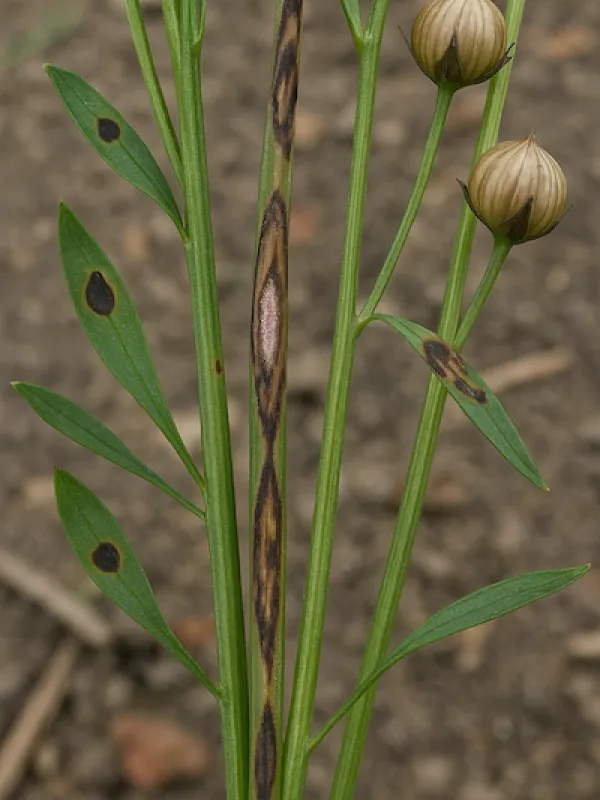
The disease affects all parts of the flax plant, appearing as small, brown-to-yellowish spots on the cotyledons and leaves shortly after emergence.
As the plant matures, stems develop elongated lesions. These lesions eventually turn brown, often causing the stem to weaken and collapse, a condition known as lodging.
A hallmark of the disease is the appearance of tiny black dots, known as pycnidia, scattered within the infected lesions on both leaves and stems.
Severe infections lead to premature yellowing and drying of the upper portions of the plant, which severely hinders the development of flowers and seed bolls.
Early-season attacks can result in seedling blight, leading to significant thinning of the stand and loss of plant population in the affected fields.
Pathogen
Pasmo is caused by the fungus Mycosphaerella linicola (anamorph Septoria linicola), which is highly specialized to infect flax (Linum usitatissimum).
The fungus survives on crop residue in the soil and can be seed-borne, making contaminated seeds a primary mechanism for introducing the disease to new areas.
During the growing season, spores (conidia) are produced within pycnidia and are disseminated primarily by rain splash and wind to healthy parts of the plant.
The pathogen also undergoes a sexual reproductive phase on over-wintered flax stems, producing ascospores that initiate new infections in the spring.
Environmental conditions dictate the speed of the disease cycle, with the incubation period shortening as moisture and temperature conditions align.
Conditions for development
Pasmo disease thrives in environments characterized by high humidity and moderate temperatures, typically between +18°C and +22°C.
Frequent rainfall during the vegetative growth period provides the necessary moisture for spore germination and rapid secondary spread within the canopy.
Dense, poorly ventilated stands retain high levels of moisture, which significantly promotes the proliferation of the fungus and accelerates the disease progression.
Short crop rotations, where flax is grown too frequently on the same land, allow the pathogen to build up high levels of inoculum in the soil.
Plants under physiological stress, often due to nutrient deficiencies or poor soil structure, exhibit lower resistance to infection compared to vigorous plants.
Why it matters
The disease causes major reductions in both seed yield and the quality of flax fiber, representing a significant financial risk to producers.
Infected stems lose structural integrity and are prone to breaking during harvest, which complicates the mechanical processing and lowers fiber yield.
Fiber quality is degraded as the infection causes discoloration and brittleness, rendering the product less desirable for the textile industry.
Seed development is severely hampered, resulting in smaller, shriveled seeds with poor germination rates, making them unsuitable for future sowing.
In cases of severe outbreaks, yield losses can range significantly, causing substantial decreases in overall farm profitability and productivity.
Protection
The primary control measure is the use of high-quality, certified, and fungicide-treated seeds to ensure that the initial infection is minimized.
Implementing a strict crop rotation of at least 5–6 years between flax crops is essential to allow the pathogen in the soil to die off naturally.
Effective management of weeds and thorough incorporation of crop residues into the soil can help reduce the primary inoculum load in the field.
Foliar fungicides should be applied preventively or at the earliest signs of the disease to curb the spread of the pathogen during the growth stages.
Selecting and breeding resistant flax varieties offers the most sustainable long-term solution for managing Pasmo disease in commercial agriculture.
Pathogens and affected parts
Affects crops · 2
Discussion
No discussions yet — be the first.