
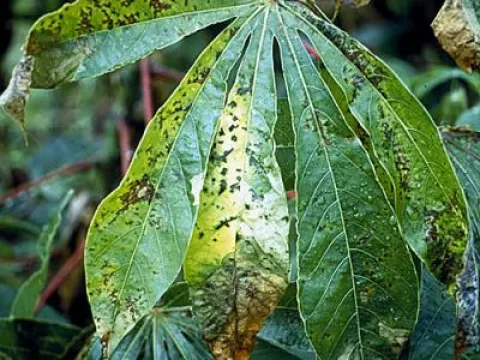
Cassava bacterial blight
Xanthomonas cassavae
The causal agent of this disease is the bacterium Xanthomonas cassavae. It is a vascular pathogen that colonizes the xylem of the cassava plant, physically obstructing the flow of sap.
What the section contains
Cassava bacterial blight
The bacterium produces extracellular polysaccharides, which accumulate in the vascular bundles, causing the typical wilting symptoms. It is a highly specialized pathogen targeting members of the Euphorbiaceae family.
The pathogen can survive in infected plant debris left in the soil after harvest. Additionally, it can persist in vegetative propagules, making the use of clean cuttings essential for disease management.
Xanthomonas cassavae is transmitted primarily through contaminated water, wind-driven rain, and infected tools. It has a high survival rate in diverse environmental conditions, complicating control efforts.
Recent studies suggest that multiple strains of the bacterium exist, varying in virulence. Continuous surveillance is necessary to detect and contain new outbreaks in commercial cultivation areas.
Early symptoms include water-soaked, angular leaf spots that often appear between the leaf veins. As the infection progresses, these spots turn yellow and eventually become necrotic, resulting in brown lesions.
Progressive wilting of the shoots is the most characteristic sign of the disease. In the early stages, leaves may wilt during the warmest part of the day and recover at night, eventually becoming permanently wilted.
Stems of infected plants often exhibit bacterial exudation. This appears as sticky, whitish or yellowish droplets that solidify into crusts on the stem surface during dry conditions.
Vascular browning and necrosis are clearly visible when the stem is cut cross-sectionally. In severe cases, the stem pith becomes soft and exhibits a distinct, foul odor due to tissue decay.
Ultimately, the plant exhibits stunted growth, leaf shedding, and eventual death. The tubers fail to develop properly and may succumb to secondary rot pathogens, resulting in total crop loss.
The disease thrives in warm and humid climates. Periods of heavy rainfall and high humidity are critical factors that facilitate the rapid multiplication and spread of the bacterium.
Wind-driven rain is a primary vehicle for the dissemination of bacteria from infected to healthy plant tissues. Splashing droplets carry the pathogen onto susceptible leaves and stems.
Close plant spacing creates a favorable microclimate by increasing humidity and reducing air movement, which promotes infection. Proper canopy management is vital to keep leaf surfaces dry.
Temperatures ranging from 25 to 30 degrees Celsius are optimal for the growth and colonization of Xanthomonas cassavae. Significant fluctuations in temperature can also stress plants and increase susceptibility.
Pest activity, particularly of insects that feed on leaves and stems, creates entry points for the bacteria. Therefore, controlling insect populations is indirectly linked to disease prevention.
The primary economic impact is a drastic reduction in tuber yield. Because the plant's vascular system is compromised, photosynthesis and nutrient distribution are severely impaired.
The quality of harvested tubers is significantly reduced, as the pathogen can cause vascular discoloration in the roots. This renders the crop unsuitable for both human consumption and industrial processing.
Cassava bacterial blight can devastate entire plantations in a single season, leading to severe food security issues in areas that rely on this crop as a staple. The loss of livelihood for smallholder farmers is immense.
The persistent nature of the bacteria in the soil makes it difficult to replant affected areas immediately. This necessitates long-term fallow periods, reducing the overall productivity of the land.
Added costs arise from the need for quarantine enforcement and the replacement of ruined stock with resistant or healthy germplasm. These costs are often prohibitive for local agricultural economies.
The most effective management strategy is the use of disease-free planting material. Establishing a clean seed system is the foundation for successfully controlling the blight in any region.
Crop rotation remains a fundamental practice to decrease the pathogen load in the soil. Planting non-host crops for several years can significantly reduce the potential for re-infection.
Strict sanitation measures must be enforced, including the regular disinfection of all farming tools with bleach or appropriate disinfectants to prevent mechanical transmission of the pathogen.
Integrated pest management is crucial to minimize the wounding of plants by insects. By keeping the crop healthy and free of pest damage, the risk of bacterial entry is substantially lowered.
Developing and deploying resistant varieties of cassava is the ultimate long-term solution. Research initiatives focused on screening germplasm for resistance are essential for future food security.