
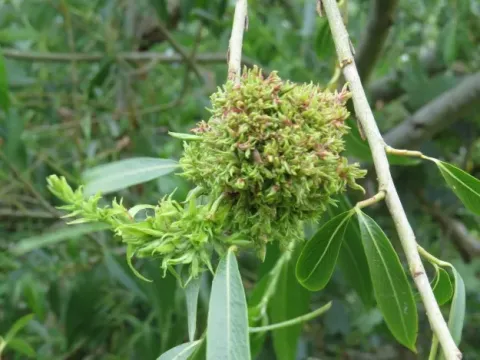
Witches broom of willow
Willow witches
The disease is caused by the fungus Taphrina epiphylla, an obligate parasite that specifically infects members of the Salix genus, leading to abnormal growth patterns.
What the section contains
Witches broom of willow
The fungus overwinters as mycelium in the bark crevices and under bud scales, remaining dormant until the favorable environmental conditions of early spring occur.
During the spring leaf-opening phase, the spores germinate and penetrate the succulent tissues of young shoots, where they start manipulating the hormonal balance of the plant.
The pathogen triggers hyper-elongation and uncontrolled cell proliferation, which results in the characteristic dense clusters of thin, stunted shoots known as witches' brooms.
The fungal mycelium is systemic and perennial; it colonizes the woody parts of the branch, allowing the disease to persist and reappear year after year on the same specimen.
The hallmark symptom is the formation of dense, tangled clusters of short and thin twigs that sprout from a single point, resembling a broom or a bird's nest in the tree canopy.
Leaves on the affected shoots are often deformed, smaller than normal, and exhibit discoloration ranging from yellowish to reddish tints due to the disturbed metabolic processes.
A fine, dusty white bloom appears on the undersides of the distorted leaves during the sporulation period, representing the fungal ascus layer where spores are produced.
These broom-like structures are structurally weak and brittle, often dying back during winter or early spring, though the underlying woody branch remains infected.
In advanced cases, the bark at the base of the witches' broom may develop fissures or necrotic spots, which can lead to localized dieback of larger branch sections.
The disease thrives in cool and damp spring weather, particularly when high humidity coincides with the initial bud-burst and shoot elongation phase of the willow tree.
Dense planting schemes that restrict air movement increase the duration of leaf wetness, creating an ideal environment for the rapid dispersal of fungal spores within the crown.
Willow trees that are already under stress due to poor soil fertility, water shortages, or physical injury are significantly more susceptible to successful fungal colonization.
Improper pruning techniques can leave open wounds that act as infection entry points, especially if the tools are contaminated and not disinfected between individual trees.
The pathogen spreads through the dispersal of spores by wind, rain splashes, and sometimes insects, which carry the spores from symptomatic trees to healthy new shoots.
The primary impact of the disease is the physiological drain on the host tree, as significant energy reserves are wasted to support the parasitic fungal growth.
The overall aesthetic value of the willow is drastically reduced, making it unsightly and unsuitable for landscape design and decorative gardening purposes.
Photosynthesis is disrupted because the abnormal leaves are inefficient, leading to stunted overall growth, reduced vigor, and increased susceptibility to other environmental stressors.
Heavy infections can cause the thinning of the canopy and premature leaf drop, which weakens the tree's ability to store energy for the subsequent growing season.
If left unmanaged, the cumulative damage can lead to the death of major branches or eventually the entire tree, especially during severe winters or prolonged drought periods.
Sanitation through aggressive pruning is the most effective control method; all witches' brooms must be removed, cutting back into healthy wood well below the infection site.
All removed infected material must be destroyed by burning or disposal in sealed containers to prevent the release of fungal spores into the local environment.
Preventative fungicide sprays, particularly those containing copper or systemic agents, should be applied in early spring just before the buds start to swell.
Maintaining the overall health of the willow through balanced fertilization and appropriate watering helps the tree mount a stronger defense against fungal pathogens.
- Regular inspection of willow trees for broom formation.
- Strict sanitation protocols for pruning tools (disinfection).
- Immediate removal and burning of infected branches.
- Avoiding excessive canopy density to improve air circulation.
- Prioritizing resistant willow cultivars for new planting projects.