
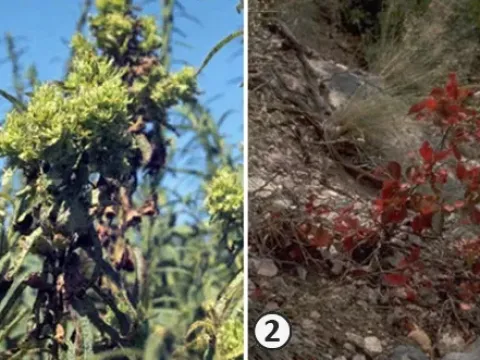
Horseweed phyllody
Horseweed phyllody
Horseweed phyllody is caused by phytoplasmas (Candidatus Phytoplasma), which are specialized wall-less bacteria residing in the phloem of infected plants. These pathogens are obligate parasites that cannot be grown in cell-free artificial media.
What the section contains
Horseweed phyllody
Transmission occurs through insect vectors, primarily leafhoppers. Once an insect feeds on an infected horseweed plant, it acquires the phytoplasma and remains infectious for the rest of its lifespan, transmitting the pathogen to healthy plants during subsequent feeding sessions.
Phytoplasmas have a broad host range, allowing them to survive in various weeds. Conyza canadensis (horseweed) serves as a primary reservoir, sustaining the disease cycle in the field environment throughout the season.
Laboratory diagnosis relies on molecular techniques like Polymerase Chain Reaction (PCR) to detect the presence of phytoplasma DNA in plant tissues. This is necessary because traditional culture methods for these pathogens do not exist.
The infection process involves the systemic movement of the phytoplasma within the plant's vascular system. Once established, the pathogen interferes with the plant's hormonal balance, leading to the characteristic morphological changes observed.
The most distinctive symptom of phyllody is the transformation of floral organs into leaf-like structures. Flower petals become green and foliaceous, completely losing their reproductive function and ability to produce seeds.
Affected plants often display "witch’s broom" symptoms, characterized by excessive branching and stunted growth. The overall architecture of the plant is altered, resulting in a bushy, deformed appearance compared to healthy specimens.
Chlorosis, or the yellowing of leaves, is a common secondary symptom, indicating metabolic disruption and impaired photosynthesis. Plants may also exhibit significant stunting, appearing much smaller than their healthy counterparts in the same field.
Floral abortion is universal in severely affected parts of the plant. Flowers either fail to form properly or are completely replaced by vegetative rosettes, rendering the plant sterile and unable to contribute to the next generation.
Symptoms are usually patchy in distribution, reflecting the feeding habits of the insect vectors. Early detection of these deformed flowers is crucial for monitoring the disease spread within the agricultural crop area.
The disease spread is heavily dependent on the activity and density of leafhopper populations. Warm and dry weather conditions generally favor the reproduction and migration of these vectors, increasing the likelihood of pathogen transmission.
The presence of wild reservoirs, especially in border areas and uncultivated lands, facilitates the persistence of the disease. Managing these nearby weed sources is a fundamental step in preventing the influx of the pathogen.
Phytoplasma epidemics often correlate with environmental factors that promote high insect activity. A larger vector population during critical growth stages of crops significantly elevates the risk of widespread infection.
Agricultural practices that affect the local microclimate or weed pressure can influence the disease trajectory. Dense weed patches provide ideal sheltered habitats for insect vectors, promoting their survival and transmission efficacy.
The timing of vector migration is often linked to seasonal climate changes. Early spring warming can trigger the insect life cycle, potentially leading to earlier infection periods in the season.
The primary damage caused by horseweed phyllody is the total loss of reproductive capacity in infected plants. This sterility impacts both seed production and the overall health of the agricultural population.
Infected plants suffer from systemic metabolic disturbances, making them weaker and more susceptible to drought, nutritional deficiencies, and secondary pest attacks. This weakens the crop and reduces overall yield quality.
The economic impact of phyllody is particularly high in seed production fields where quality standards are strict. A high incidence of infection can lead to complete loss of marketable product.
Since phytoplasmas disrupt the vascular tissue, nutrient transport is hindered. This results in poor development of root systems and foliage, ultimately leading to plant decline or premature death.
If the disease spreads to neighboring economically valuable crops, the potential for financial loss increases significantly. Managing the disease prevents it from becoming an established issue within the agroecosystem.
The core management strategy is the rigorous control of reservoir weed populations, particularly horseweed (Conyza canadensis). Eliminating these hosts disrupts the life cycle of the pathogen and its insect vectors.
Insecticide applications targeted at leafhoppers help reduce vector density and lower the risk of infection. Effective vector control must be timed according to insect migration patterns observed during the growing season.
Using certified, pathogen-free seeds or planting material is essential to prevent the introduction of the disease into new areas. Regular scouting for symptomatic plants and their immediate removal can limit the spread.
Spatial isolation between new crops and known infection sites can significantly protect fields. Rotating crops and practicing good field sanitation reduce the favorable habitats available to leafhopper vectors.
Currently, there are no curative chemical treatments for phytoplasma-infected plants. Therefore, an integrated approach focusing on prevention, vector suppression, and sanitation is the only effective solution for growers.