
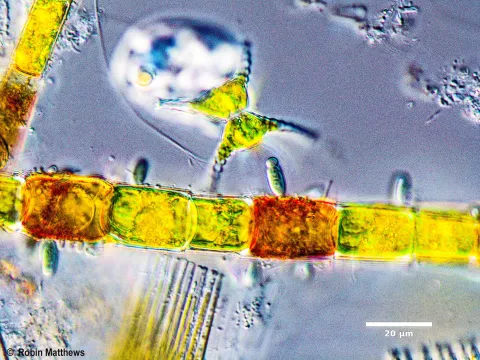
Chamaesiphonaceae
Chamaesiphonaceae
Chamaesiphonaceae are a family of cyanobacteria characterized by unicellular or colonial growth habits, often found as epiphytes on submerged surfaces.
What the section contains
Chamaesiphonaceae
They do not function as true pathogens that invade plant tissues, but rather as opportunistic organisms that colonize the surface of plant stems and roots.
These organisms reproduce via exospores, which are released into the water column and easily spread throughout irrigation or hydroponic systems.
As photoautotrophs, they rely on light and dissolved inorganic nutrients, making them particularly problematic in high-tech greenhouse environments.
Understanding their taxonomy and life cycle helps agronomists distinguish them from more destructive plant diseases and manage them appropriately.
The presence of these organisms is visually identified by a characteristic slimy coating, ranging from blue-green to brown, on submerged plant parts.
The coating typically sits on the surface of the plant epidermis rather than infiltrating the tissue, distinguishing it from fungal infections.
Dense colonies may block sunlight from reaching the leaves, leading to chlorosis or a general decline in the plant's metabolic activity.
Microscopic examination reveals individual cells or clusters anchored to the substrate by a distinct mucilaginous stalk or base.
A foul odor may be associated with the area where large colonies have developed and subsequently begun to decompose.
Development is heavily dependent on nutrient availability, specifically high concentrations of phosphorus and nitrogen in the aqueous medium.
Exposure to light is essential for their photosynthetic activity, meaning they thrive in well-lit hydroponic channels or irrigation ponds.
Optimal temperatures for rapid proliferation typically range between 20°C and 28°C, which aligns with standard greenhouse growing temperatures.
Stagnant or slow-moving water facilitates the settlement and attachment of exospores to plant roots and system components.
A lack of proper filtration and sterilization in closed-loop systems provides a perfect breeding ground for Chamaesiphonaceae colonies.
The primary damage is mechanical, as the colonies create a physical film that impedes photosynthesis and gas exchange in plant tissues.
On roots, the slime coating significantly reduces the surface area available for nutrient uptake, causing stunted growth and nutrient deficiencies.
In irrigation systems, the slime can clog pipes, emitters, and filters, causing a breakdown in the uniform water distribution to crops.
Decaying colonies release metabolic waste products that can adversely affect the plant's rhizosphere and increase stress levels.
Their rapid growth necessitates increased maintenance, labor, and costs associated with system sanitization and crop remediation.
Manual cleaning and physical removal of the algal slime from plants and system walls is the first step in effective management.
Installing UV sterilization units in the water supply and recirculation systems is highly effective at neutralizing spores.
Regular maintenance of filtration systems is crucial to remove organic debris that provides a substrate for colonization.
Optimizing nutrient management to prevent the accumulation of excess nitrogen and phosphorus can curb rapid algal blooms.
Utilizing certified algicides in strict accordance with the label can help manage populations without damaging the target crop.