
Carrot motley dwarf virus
Umbravirus carotae
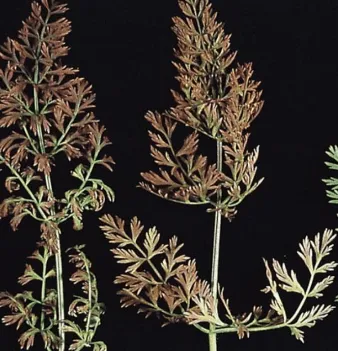
Description
Symptoms
The characteristic signs of this infection include distinct yellowing or reddening of the carrot leaves, which typically starts from the margins and progresses inward.
Infected plants show stunted development, with significantly reduced leaf size and an overall bushy appearance that distinguishes them from healthy crops.
The taproots of diseased carrots are often stunted, woody, and may exhibit excessive development of fine fibrous roots, referred to as a "hairy root" condition.
Leaf curling and deformation are common, often leading to a significant reduction in the plant's photosynthetic surface area and general vigor.
These visual symptoms are most prominent as the plants mature, often leading to a patchy appearance across the field where infected areas stand out.
Pathogen
The causative agent is Umbravirus carotae, a virus that relies on specific ecological interactions for its survival and transmission within carrot crops.
The disease is transmitted in a persistent manner by the willow-carrot aphid, Cavariella aegopodii, which serves as the primary vector.
Once the aphid feeds on an infected plant, the virus is ingested and moves into the salivary glands, where it remains for the duration of the insect's life.
The virus does not multiply within the vector, but it can be efficiently transmitted to healthy host plants during subsequent feeding episodes.
The pathogen is not seed-borne, meaning the primary source of infection in new seasons is the migration of viruliferous aphids from overwintering sites.
Conditions for development
Environmental conditions that favor the rapid multiplication and migration of Cavariella aegopodii are the main drivers of disease outbreaks.
Warm, dry spring weather often accelerates the aphid lifecycle, leading to earlier and more severe infections in young, vulnerable carrot seedlings.
The presence of nearby wild or volunteer umbelliferous plants acts as a reservoir for both the virus and the aphid population throughout the year.
Strong winds can facilitate the long-distance spread of winged aphids, carrying the virus into previously uninfected carrot production areas.
Poor field hygiene, such as failing to remove crop debris or secondary hosts, creates an ideal environment for the persistence of the pathogen in the landscape.
Why it matters
The economic impact of this disease is substantial, resulting in significant yield losses due to stunted root growth and reduced plant vitality.
Quality reduction is a major issue, as affected roots are often small, misshapen, and possess poor storage characteristics, making them unmarketable.
The disease degrades the nutritional profile of the carrots, lowering sugar and carotenoid levels, which impacts both consumer acceptance and processing quality.
Severely stressed plants become more susceptible to secondary soil-borne pathogens, further accelerating the decline and decay of the crop in the field.
In severe infestation cases, the total loss of the crop is possible, requiring costly re-plowing or abandonment of the affected portions of the field.
Protection
Managing the aphid vector is the most effective approach, utilizing timely applications of systemic insecticides once threshold populations are detected.
Spatial isolation is critical; planting new carrot crops far from old fields or overwintering host plants significantly reduces the risk of initial infection.
The use of floating row covers during the early stages of carrot development can provide a physical barrier against aphid feeding and virus transmission.
Strict weed management, focusing on the removal of wild hosts within the Umbelliferae family, is essential to decrease local viral reservoir populations.
- Regular monitoring of aphid populations using sticky yellow traps.
- Selection of carrot varieties that show field tolerance to the disease.
- Strategic planting times to avoid peak migration periods of the aphid vector.
Discussion
No discussions yet — be the first.