
Description
Symptoms
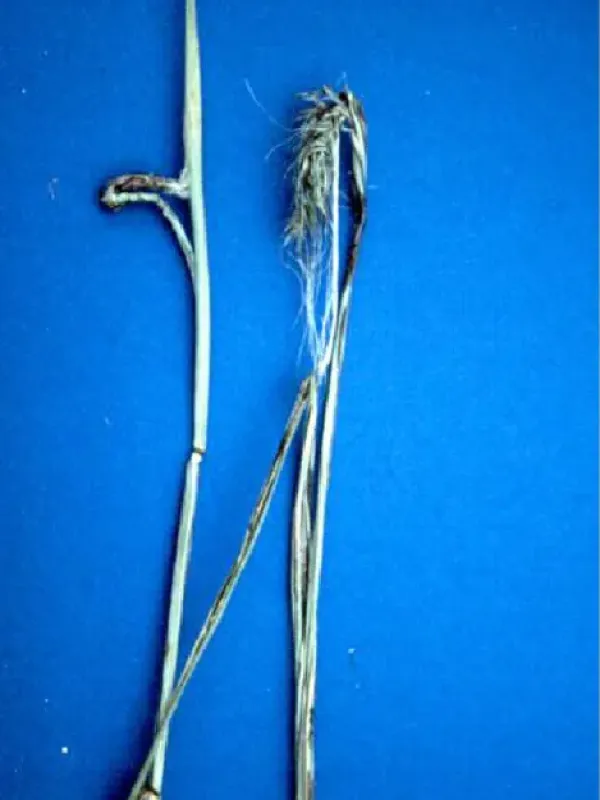
The most visible symptom is the development of long, lead-gray to black stripes on the stems and leaf sheaths. These stripes consist of fungal spores breaking through the plant tissue.
Infected plants are often stunted, exhibiting significantly reduced growth compared to healthy crops. They may fail to produce a normal, productive head (ear) due to the systemic nature of the infection.
Affected stems become brittle and may split longitudinally, exposing the dark, powdery spore masses inside. This tissue damage weakens the entire structural integrity of the plant.
Heavily infested fields appear thin, with numerous plants showing signs of twisting or curling. If a head is formed, it is usually distorted, poorly developed, and fails to fill with grain.
- Dark longitudinal streaks on stems
- Ruptured epidermis with black spores
- Stunted plant growth
- Distorted or absent grain heads
- Increased brittleness of stalks
Pathogen
The pathogen responsible for this disease is the fungus Urocystis occulta, a specialized parasite within the smut fungi group. It primarily targets rye crops, showing high specificity to this host.
Infection occurs either through seed-borne teliospores or via soil contamination. These spores are highly resilient and can remain viable in the soil for several years, posing a long-term risk.
The critical window for infection is during the germination phase of the rye seedling. The fungus invades the host tissue while the seedling is still underground.
Once inside, the fungal mycelium grows systemically through the plant tissues, traveling through the internodes as the stem elongates. The fungus drains energy from the host throughout the growing season.
As the plant nears maturity, the fungus produces masses of black teliospores. These break through the plant epidermis, manifesting as characteristic black streaks on the stems and leaf sheaths.
Conditions for development
The primary factor for Urocystis occulta development is soil temperature during the planting season. Infection is most aggressive at moderate temperatures, typically between 10°C and 15°C.
High soil moisture levels significantly promote spore germination and subsequent invasion of the seedling. Prolonged wet conditions at planting time exacerbate the severity of the disease.
Late seeding, which often coincides with cooler soil temperatures, frequently leads to higher rates of smut infection in winter rye crops.
Crowded planting densities create a microclimate that traps moisture around the base of the plants, facilitating the spread and successful entry of the fungus into the seedlings.
Continuous cropping of rye without adequate rotation results in the accumulation of soil-borne teliospores, ensuring that the disease persists in the field over multiple seasons.
Why it matters
Rye stem smut causes significant yield losses by reducing the number of grains per head and decreasing overall plant vigor. In severe cases, entire stalks may be rendered barren.
The quality of the straw is severely degraded. Infested stems are often unsuitable for livestock feed, as the presence of high concentrations of fungal spores may cause toxic reactions.
Weakened plants are more susceptible to other diseases and environmental stresses. This cumulative stress leads to thinning of the crop stand and reduced resilience of the field.
The long-term presence of spores in the soil restricts the choice of crops for rotation. Growers may be forced to avoid planting rye in infected fields for several years to break the cycle.
Financial impact stems from both direct yield reduction and the necessary investment in high-quality chemical seed treatments required to manage the pathogen.
Protection
The most effective strategy for managing rye stem smut is the use of systemic fungicides for seed treatment. This kills surface-borne spores and protects the seedling during its most vulnerable stage.
Crop rotation is essential for disease management. Avoiding rye on the same field for at least 3–4 years allows the soil spore population to decline naturally.
Utilizing resistant or tolerant rye varieties is a recommended practice that reduces reliance on chemical interventions while maintaining stable productivity.
Adjusting seeding times can minimize the overlap between the seedling's vulnerable stage and the optimal temperature window for fungal infection.
Good soil management, including deep plowing and the thorough incorporation of crop residues, helps speed up the decomposition of plant debris, thereby reducing the infectious inoculum in the field.
Pathogens and affected parts
Affects crops · 1
Discussion
No discussions yet — be the first.