

Description
Symptoms
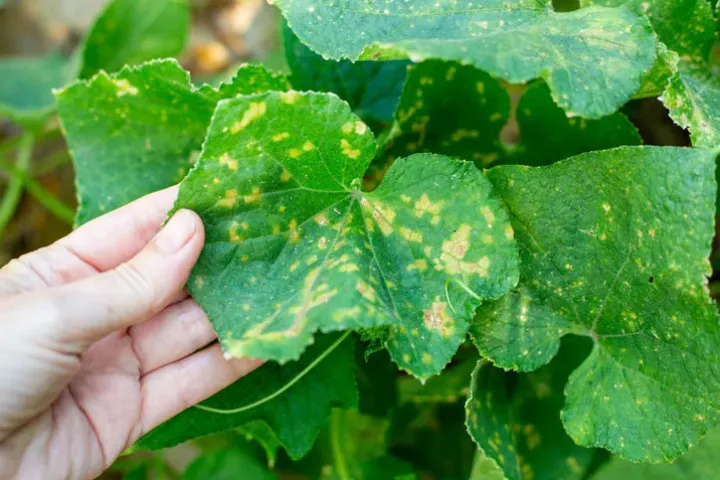
The disease is marked by distinct yellow mosaic patterning on leaves, which usually appears as chlorotic spots evolving into complex yellow-green mottling.
Leaves exhibit severe distortion, blistering, and extreme narrowing, often resulting in a filiform (thread-like) appearance of the foliage.
Fruits are severely affected, showing characteristic bumps, irregular protrusions, and distorted shapes that render them commercially unmarketable.
Systemic infection leads to stunted plant growth, shortened internodes, and a significant reduction in the number of flowers and fruit set.
Early-stage infection usually results in the total loss of productivity for the affected plant, which remains a source of inoculum for the rest of the field.
Pathogen
Zucchini yellow mosaic virus (ZYMV) is a member of the genus Potyvirus, characterized by its long, flexuous, filamentous viral particles.
It has a wide host range among the Cucurbitaceae family, infecting zucchinis, pumpkins, cucumbers, watermelons, and melons, as well as several wild weeds.
Transmission occurs primarily through aphids in a non-persistent manner, meaning the virus is acquired and transmitted within seconds of probing or feeding.
Mechanical transmission is also common, occurring through contaminated pruning shears, harvesting equipment, or handling by field workers.
While seed transmission is possible in some cases, the main drivers of field outbreaks are aphid activity and the presence of infected reservoir plants.
Conditions for development
Optimal conditions for ZYMV development include warm temperatures that favor rapid aphid reproduction and movement between plants.
Wild weeds in the vicinity of production areas serve as primary viral reservoirs, surviving throughout the winter and bridging the gap between crop seasons.
High planting density increases the likelihood of inter-plant contact and facilitates the movement of aphid vectors across the entire crop canopy.
The virus spreads most aggressively when aphid populations peak, typically following weather patterns that encourage insect migration.
The lack of proper sanitation and weed management provides a continuous source of inoculum, sustaining the infection cycle in agricultural environments.
Why it matters
ZYMV is considered one of the most destructive diseases of cucurbits worldwide, often causing total crop failure in susceptible varieties.
Economic impact stems from the complete loss of fruit quality, as deformed and mottled zucchini or pumpkin fruits cannot be sold at market.
The rapid spread of the virus across a field can compromise an entire season's production within just a few weeks of the first infestation.
Infected plants serve as persistent sources of the virus, making it difficult to protect surrounding healthy plants once the disease is established.
Besides direct yield loss, growers face increased costs related to pest management and the labor-intensive removal of symptomatic plants.
Protection
Since there are no curative treatments for viral plant diseases, management focuses heavily on prevention and the disruption of transmission cycles.
Integrating chemical control of aphid vectors with consistent weed control around fields is essential to reduce the initial infection pressure.
Using certified, virus-free seeds and selecting resistant or tolerant hybrid varieties are the most effective long-term strategies for growers.
Physical barriers such as floating row covers can protect young plants from aphid colonization during the most vulnerable growth stages.
- Planting resistant or tolerant cultivars
- Removing symptomatic plants promptly to reduce inoculum
- Controlling weeds in and around fields
- Managing aphid populations with appropriate insecticides
- Disinfecting all tools and equipment regularly
Content graph
Connections · Zucchini yellow mosaic virus
Most often together:
Marketplace
Products · 2

Community
Discussion
No discussions yet — be the first.