
Description
Symptoms
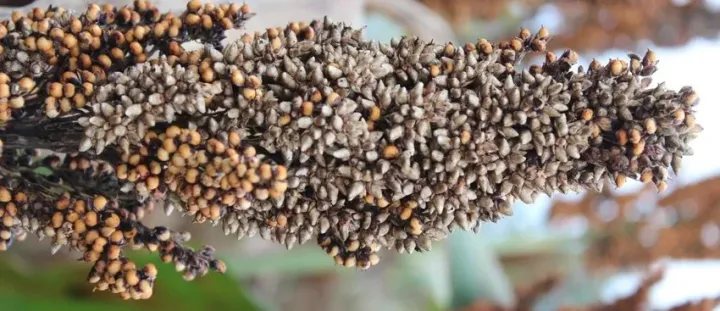
The primary symptom of the disease is the replacement of grains in the sorghum panicle with hard, cone-shaped structures called sori. These structures are covered by a grayish-brown membrane that protects the spores inside.
Affected plants often appear stunted and show increased tillering compared to healthy plants. This occurs because the pathogen influences the host's hormonal balance, triggering premature development of axillary buds.
If the membrane of the sorus is ruptured, a dark, powdery mass of spores is revealed. This mass consists of millions of teliospores that can be easily dispersed by the wind or through harvesting equipment.
Unlike loose smut, where spores disperse rapidly, the sori in covered kernel smut remain intact for a long time. This is a crucial visual distinction for identifying the disease in the field before harvest.
- Deformation of the sorghum panicle.
- Appearance of hard "sacs" instead of normal kernels.
- Presence of a dark powdery spore mass inside the sori.
- Stunted growth and increased plant tillering.
Pathogen
The causal agent of this disease is the specialized fungus Sporisorium sorghi (formerly known as Sphacelotheca sorghi). This microorganism belongs to the Basidiomycota phylum and is an obligate parasite that specifically infects plants of the genus Sorghum.
The infection persists as teliospores on the surface of seeds or within the soil. The fungus's life cycle begins during seed germination, when spores activate and penetrate the developing seedling, spreading systemically through the plant's tissues throughout the growth season.
The fungus develops covertly inside the plant stems without external symptoms until the flowering stage. At this point, the pathogen begins to transform the floral organs into sori, which are structures filled with fungal spores.
Teliospores have smooth walls, providing them with significant resilience against harsh environmental conditions. They can remain viable in the soil for several years, waiting for the right conditions to infect new susceptible hosts.
The disease is classified as a smut, where reproductive parts of the plant are completely replaced by spore masses. It is a systemic infection that invariably leads to the loss of crop yield in affected plants.
Conditions for development
The optimal conditions for infection are moderate soil moisture and air temperatures ranging from +18°C to +25°C. These conditions promote the rapid activation and penetration of fungal hyphae into the young seedling.
Planting in cold, wet soil significantly delays seedling emergence, extending the period during which the plant is vulnerable to infection. This is a primary factor in the prevalence of the disease across large fields.
Spore dissemination occurs via air currents during harvesting or through contaminated machinery. Planting sorghum continuously on the same field promotes the accumulation of inoculum in the soil.
The depth of seed sowing is also significant: deeper sowing increases the time a seedling spends underground, raising the probability of successful penetration by the fungus.
While environmental factors influence the progression of the disease, the primary driver remains the presence of infected seeds or infested soil, making sanitation crucial.
Why it matters
The primary damage is the complete loss of grain in affected panicles. The sori contain no nutritional value and contaminate the rest of the grain during harvest, making the entire yield unsuitable for food or feed processing.
Yield losses can be severe in years with high disease pressure, sometimes reaching 40% or more. Economic damage includes both the lost production and the increased costs of cleaning and processing contaminated grain.
Spore contamination of seeds significantly reduces their viability and germination rates. Such seeds require intensive fungicide treatment before they can be used for planting again.
The systemic nature of the infection weakens the overall physiological state of the crop, making it more susceptible to secondary diseases and pests, thereby reducing the field's productivity.
The accumulation of spores in the soil restricts crop rotation options, forcing producers to avoid planting sorghum on the same plot for several consecutive years.
Protection
The most effective method of control is the preventive application of systemic fungicides to seeds before sowing. This creates a protective barrier that eliminates surface-borne spores and protects the seedling.
Strict adherence to crop rotation is vital for reducing the pathogen pressure in the soil. It is recommended to avoid planting sorghum on the same field for at least 3 to 4 years.
Choosing resistant sorghum varieties and hybrids is the best long-term strategy for minimizing disease risks. Using certified, high-quality seeds ensures that the initial inoculum level is kept to a minimum.
Optimizing planting dates ensures that seedlings emerge quickly when soil temperatures are warm, reducing the window of susceptibility to the fungus.
Regular sanitation of harvesting equipment and storage facilities is essential to prevent the spread of spores between different fields and across different batches of harvested grain.
Pathogens and affected parts
Affects crops · 1
Discussion
No discussions yet — be the first.