

Description
Symptoms
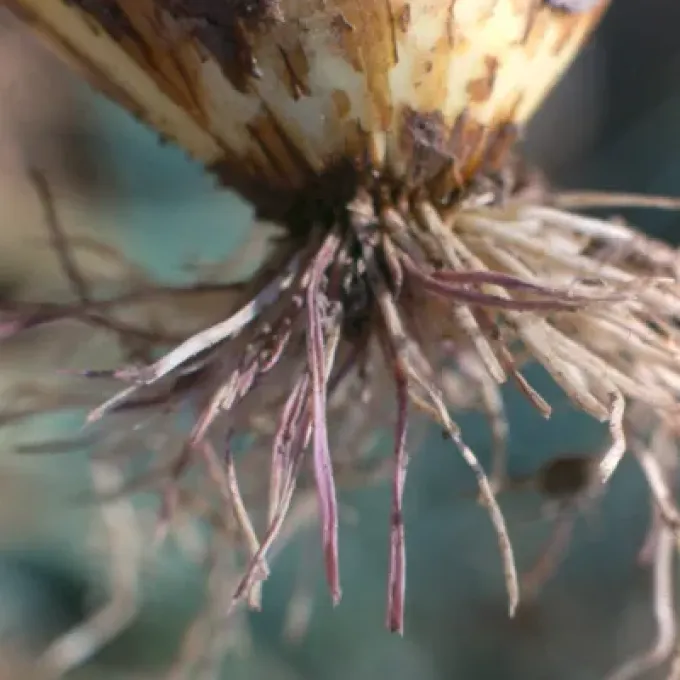
The hallmark symptom is the distinct pink discoloration of the root system. As the disease progresses, these roots turn dark purple, brown, or black and eventually begin to decay, leading to significant root loss.
Affected roots become brittle and lose their structural integrity, which prevents them from absorbing sufficient water and nutrients. This loss of root mass is reflected in the stunted growth of the plant's above-ground parts.
Leaves of infected plants often show signs of water stress, specifically tip dieback or yellowing, even when moisture levels in the soil are adequate. This is because the damaged root system cannot support the plant's needs.
In the field, the disease typically appears in patches where plant development is noticeably uneven compared to healthy areas. These patches tend to expand over time if the environmental conditions remain favorable for the fungus.
Correct diagnosis is essential and involves examining the root system for the characteristic pink hue, which helps distinguish Pseudopyrenochaeta terrestris from other soil-borne pathogens that cause root decay.
Pathogen
The causal agent of pink root rot is the soil-borne fungus Pseudopyrenochaeta terrestris (formerly known as Pyrenochaeta terrestris). It is a persistent pathogen that can survive in the soil for several years as mycelium or sclerotia.
This fungus is a facultative parasite, meaning it can thrive both on living roots and on decomposing organic matter. This biological versatility makes it extremely difficult to eradicate once it becomes established in a field.
The infection spreads primarily through contaminated soil, irrigation water, and the movement of agricultural equipment. Once present in the rhizosphere, the pathogen colonizes the roots of susceptible plants, leading to severe dysfunction.
The life cycle of the pathogen is highly temperature-dependent, with warmer conditions significantly accelerating its metabolic activity. The fungus is well-adapted to surviving across various environmental conditions, making it a major agricultural challenge.
Monoculture farming practices are the primary driver for the build-up of this pathogen in agricultural soils. Over time, the concentration of the fungus reaches a threshold where it can severely limit the growth of high-value crops.
Conditions for development
Pink root rot is most severe in warm soil conditions. The optimal temperature range for the fungus to cause maximum damage is between 24°C and 28°C, often occurring during the peak of the growing season.
High soil moisture combined with poor drainage creates a perfect environment for the fungus to proliferate and attack healthy roots. Waterlogged soils significantly exacerbate the spread and virulence of the pathogen.
Soil pH and fertility levels can influence the disease, although the fungus is relatively broad-spectrum in its requirements. Intensive cropping systems that lack adequate rotation cycles are the primary cause of widespread infection.
Plants that are already under stress due to drought, low nitrogen, or physical root injury are much more susceptible to the infection. Any factor that weakens the plant's natural defense increases the risk of successful fungal invasion.
Compact, poorly aerated soils contribute to the disease by weakening the plant's root health, thereby providing the fungus with an easier pathway into the inner tissues of the root system.
Why it matters
The disease is economically devastating for the onion and garlic industry worldwide. It significantly reduces yield by stunting plant growth and forcing the plant to prioritize survival over bulb development.
Infected bulbs are typically small, undersized, and lack the market quality required for premium sales. Furthermore, the root damage results in a significantly reduced ability of the plant to withstand environmental stress.
Post-harvest losses are a major concern, as bulbs grown on infected soils often have reduced shelf life and are more susceptible to secondary storage rots, causing further financial strain on the producer.
The total loss of potential yield is especially high in years with long, warm summers that favor fungal growth. In severe cases, the entire crop in a specific area may be lost or rendered completely unsalable.
Managing pink root rot is difficult because it is a long-term problem. Once the pathogen is established in the field, it remains a threat for many years, requiring producers to adopt long-term management strategies.
Protection
Long-term crop rotation is the most effective management strategy. Susceptible crops should not be grown in the same field for at least 5 to 6 years, allowing the fungal population in the soil to decline.
The use of resistant or tolerant cultivars is highly recommended, especially in regions with a known history of the disease. This is the cornerstone of an integrated pest management approach for pink root rot.
Improving general soil health and structure through proper drainage, balanced fertilization, and the use of organic amendments can help plants resist the initial stages of infection.
- Use certified, disease-free transplants or seeds.
- Avoid irrigation practices that keep the soil saturated for extended periods.
- Implement strict sanitation measures for all farm tools.
- Deep plowing to improve soil aeration and reduce surface pathogen density.
Chemical control, including soil fumigation or the application of specialized fungicides, may be considered in intensive greenhouse or high-value production systems, though it is costly and should be used as a last resort.
Reference
Connections · Pink root rot
Most often together:
Marketplace
Products · 3


Community
Discussion
No discussions yet — be the first.