
Description
Symptoms
The first and most characteristic symptom of the disease is the localized wilting of individual shoots or an entire carnation plant, often starting with the lower leaves. Gradually, the affected parts of the plant take on a grayish-green, and subsequently yellow or brown, discoloration.
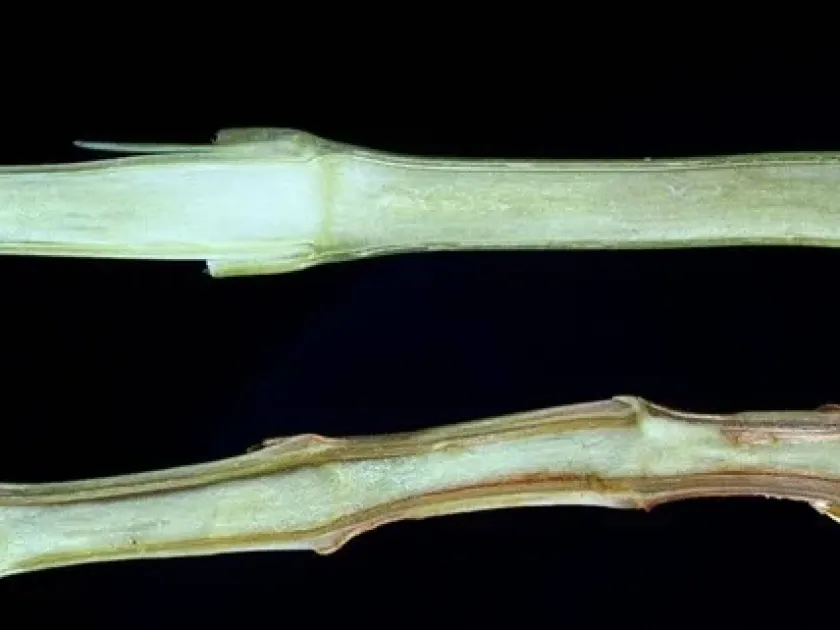
In the later stages of infection, a characteristic deformation of the stems occurs, leading to twisting and growth arrest, rendering the flower unsuitable for market. Cross-sections of the stem clearly show browning of the vascular bundles, indicating a systemic infection of the conducting system.
The root system of the diseased plant may look visually healthy in the initial stages, but as the pathogen progresses, the roots start to turn brown and gradually decay. Under high humidity conditions, a weak grayish mycelial coating may appear on the lower part of the stem.
The infection often has a focal character, spreading in patches throughout the greenhouse, which is associated with the transport of fungal spores through soil and water. Plants that have been attacked by the pathogen rarely recover and, in most cases, must be completely removed.
Diagnosing the disease is complicated by the fact that external wilting symptoms can be similar to other types of Fusarium-related infections. Accurate identification requires laboratory examination of stem cross-sections for the presence of specific fungal spores.
Pathogen
The causative agent of the disease is the microscopic fungus Phialophora cinerescens, which belongs to the class of deuteromycetes (imperfect fungi). This is a soil-borne pathogen capable of maintaining viability in the substrate for a long time in the form of chlamydospores.
The fungus enters the plant through the root system, most often through mechanical injuries sustained during planting or soil cultivation. Once inside, the mycelium actively grows in the xylem vessels, clogging them and preventing the normal movement of water and nutrients.
In the process of its metabolism, the pathogen releases specific toxins that cause general poisoning of the plant organism and accelerate the wilting process. The spores of the fungus, called phialospores, are formed in specific structures called phialides, which gave the genus its name.
The biology of the pathogen is closely tied to its ability to exist saprotrophically in the soil in the absence of the primary host plant. Thanks to this property, the pathogen can remain in greenhouse soil for decades, waiting for favorable conditions to restart the infection cycle.
Infection transmission occurs not only through contaminated soil but also through infected planting material and tools that have been in contact with diseased plants. The high degree of fungal specialization makes it extremely dangerous for industrial floriculture.
Conditions for development
The development of Phialophora wilt is favored by soil temperatures in the range of 15 to 20 degrees Celsius, which is the optimal condition for spore germination. Higher temperatures may slow down pathogen development, but they do not eliminate it completely.
High air humidity and waterlogged soil create the ideal environment for the active multiplication and spread of the fungal mycelium. Violation of irrigation management is the main trigger for mass outbreaks of the disease in greenhouse conditions.
The presence of compacted soil with poor aeration promotes stagnation, which facilitates the invasion of the fungus into the root system. It is in such zones that the fastest rates of carnation tissue necrosis are observed.
Soil acidity also plays an important role: the fungus prefers slightly acidic or neutral substrates. Adjusting soil acidity towards alkalinity can in some cases inhibit the development of the infection, although this method requires caution.
Overcrowded carnation plantings prevent normal ventilation of the root zone, creating a microclimate with high humidity at the soil surface. This significantly increases the risk of secondary infection of healthy neighboring plants through soil capillaries.
Why it matters
Phialophora wilt is considered one of the most destructive carnation diseases, capable of leading to total crop loss in protected ground environments. Loss levels can reach 80-100 percent of the total planting if hygienic measures are not followed.
The damage is manifested not only in the direct death of plants but also in a significant reduction in the quality of commercial produce. Flowers from affected plants often have weak stems and small buds, making them unsuitable for floral arrangements.
The infection makes it impossible to grow carnations in the same spot for many years without full replacement or sterilization of the soil. This entails huge economic costs for greenhouse farms associated with substrate replacement.
The constant presence of the pathogen in the production zone forces the use of expensive fungicides, which increases the cost price of the final flower product. The environmental load on the greenhouse due to intensive chemical treatment also increases.
The risk of spreading the infection to adjacent greenhouse sectors via drainage water or equipment makes Phialophora wilt a systemic threat to the entire enterprise. This requires strict adherence to phytosanitary control at all stages of production.
Protection
The primary method of control is the use of healthy, certified planting material obtained through meristem propagation. This is the only way to avoid introducing the pathogen via cuttings during the early stages of vegetation.
An effective preventive measure is thermal sterilization of the soil before planting, especially if cases of wilting were previously recorded in that area. Steam treatment of the soil at high temperatures reliably destroys fungal spores.
During cultivation, it is necessary to strictly follow the irrigation regime, avoid waterlogging, and regularly disinfect tools with working solutions of fungicides or alcohol-based compositions. Equipment should be assigned to specific greenhouse zones.
Upon detection of individual diseased plants, they should be immediately removed along with the root ball and burned outside the greenhouse premises. The remaining planting holes and neighboring plants are recommended to be treated with systemic fungicides to prevent mycelial spread.
Among chemical means of protection, the most effective are preparations from the benzimidazole and triazole groups, which are applied for soil drenching and plant spraying. It is important to rotate fungicides to prevent the development of resistance in the fungal population.
Pathogens and affected parts
Affects crops · 1
Discussion
No discussions yet — be the first.