
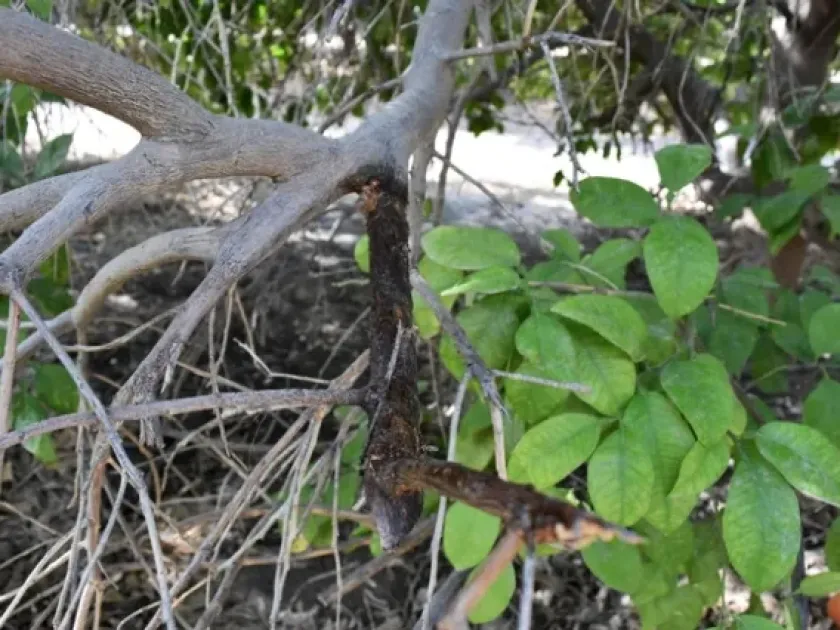
Description
Symptoms
The most distinctive sign is the sudden flagging and wilting of individual branches, which appear brown and scorched as if affected by high heat.
Longitudinal cracks often appear on the bark, accompanied by the exudation of sap or gum, indicating the internal damage caused by the fungal mycelium.
If the bark is peeled back, one can observe a distinct dark, often black, fungal mat covering the cambium and xylem layers of the wood.
Leaves on infected branches typically turn yellow and wither prematurely, remaining attached to the branch for an extended period.
As the infection progresses, the wilt spreads toward the main scaffold branches and eventually the trunk, leading to the tree's eventual decline.
Pathogen
The disease is caused by the fungus Hendersonula toruloidea (also known as Scytalidium dimidiatum), which is a serious pathogen affecting various woody plants.
This fungus is a filamentous pathogen that invades the vascular system of the host tree, effectively cutting off the supply of water and nutrients.
It is well-adapted to warm and arid climates, allowing it to remain active and highly aggressive during hot summer months when other fungi might go dormant.
The fungus produces spores that can be easily dispersed by wind, splashing rain, and by insects or pruning tools, facilitating rapid spread within an orchard.
It survives in dead wood and bark, making it a persistent pathogen that can survive for several seasons in discarded branches or stumps.
Conditions for development
High temperatures are the primary driver of disease development, especially when combined with water stress or drought conditions that weaken the tree.
The pathogen primarily enters the tree through open wounds caused by mechanical damage, including sunscald, wind damage, or improper pruning practices.
Orchards under high stress due to insufficient irrigation are significantly more susceptible to Hendersonula toruloidea outbreaks.
Insects that bore into the bark serve as vectors for the fungus, carrying spores deep into the tree where infection can quickly establish.
Dense canopies with poor air circulation can also create localized microclimates that occasionally favor the survival and spread of the pathogen.
Why it matters
Branch wilt significantly reduces nut production by eliminating the fruit-bearing surface of the tree and exhausting the tree's energy reserves.
The disease reduces the structural integrity of the walnut tree, increasing the risk of branch breakage during high winds or heavy crop loads.
It leads to a reduction in the economic lifespan of the orchard, requiring costly removal and replacement of mature trees that can no longer recover.
The infection is often chronic, meaning that a tree can remain a source of inoculum for several years before finally succumbing to the disease.
Rapid spread throughout an orchard can lead to significant yield losses for commercial growers, potentially threatening the viability of the entire plantation.
Protection
The most effective control measure is aggressive sanitation, which involves pruning out all infected branches at least 15-20 cm into healthy tissue.
Sanitized pruning tools must be cleaned between each cut to prevent the accidental transfer of spores from infected to healthy wood.
All removed branches must be promptly removed from the orchard and burned to prevent the fungus from sporulating and spreading further.
Maintaining tree vigor through consistent irrigation and balanced fertilization is essential to help the tree maintain its natural defense mechanisms.
- Use copper-based fungicides for preventive spraying.
- Apply white latex paint to trunks to prevent sunscald.
- Monitor and control wood-boring insects.
- Sanitize tools with bleach or alcohol solutions.
Pathogens and affected parts
Affects crops · 1
Discussion
No discussions yet — be the first.