

Description
Symptoms
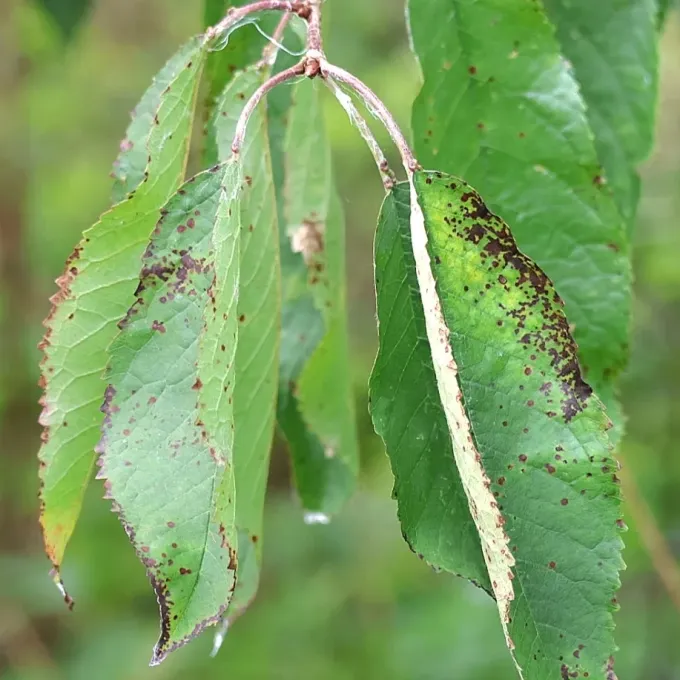
The first symptoms appear on the upper leaf surface as tiny, circular, purple to reddish-brown spots that gradually increase in size.
As the infection progresses, these spots often coalesce, causing severe damage to the leaf tissue and leading to premature leaf drop.
Small, whitish-pink masses of spores become visible on the underside of the leaf, directly beneath the necrotic spots.
Heavy infections lead to massive yellowing of foliage and defoliation, which can occur as early as mid-summer under favorable disease conditions.
Fruit infection can also occur, resulting in depressed, necrotic lesions that significantly reduce the quality and market value of the crop.
Pathogen
The causative agent of the disease is the ascomycete fungus Blumeriella jaapii (syn. Cylindrosporium hiemale), which primarily attacks stone fruit trees.
The fungus overwinters in fallen leaves as mycelium, where apothecia develop in early spring, releasing ascospores that initiate primary infection.
During the growing season, the fungus spreads through conidia produced in white-colored tufts on the underside of infected leaves.
The life cycle of the pathogen is highly dependent on humidity, as the spores require water films on the foliage to germinate and penetrate through stomata.
Sanitation of the orchard floor is critical, as the fungus relies solely on leaf litter to complete its annual biological cycle.
Conditions for development
The development of the disease is favored by warm, humid weather with frequent rain showers during the spring and early summer.
Optimal temperatures for spore germination and infection are between 18 and 22 degrees Celsius in the presence of leaf wetness.
Dense tree canopies and poor orchard spacing create a stagnant microclimate that encourages rapid fungal reproduction and spread.
Prolonged rainfall events facilitate the dispersal of spores from the ground to the lower foliage, triggering epidemic outbreaks.
Neglecting orchard hygiene allows the pathogen to build up significant inoculum pressure, making subsequent control much more difficult.
Why it matters
Cherry leaf spot is a devastating disease for commercial and home cherry growers, leading to substantial yield losses.
Defoliation disrupts photosynthesis, preventing trees from accumulating sufficient carbohydrate reserves needed for winter hardiness.
Weakened trees are highly susceptible to cold injury during winter, which can lead to permanent damage or tree death.
Fruit quality is severely impacted as affected trees often produce smaller, undersized, and tasteless fruit due to early leaf loss.
Successive years of heavy infection eventually exhaust the tree's resources, resulting in a decline in productivity and total orchard decline.
Protection
The most important control measure is the removal and destruction of fallen leaves, which effectively reduces the primary inoculum source.
Apply copper-based fungicides early in the season before bud break to suppress the development of fungal fruiting bodies.
During the growing season, implement a regular spray program using systemic and contact fungicides to protect new growth.
Proper pruning and orchard management are essential to improve air circulation and reduce the duration of leaf wetness.
- Use resistant or tolerant cultivars.
- Ensure balanced fertilization.
- Monitor for early symptoms to time fungicide sprays.
Content graph
Connections · Cherry leaf spot
Most often together:
Marketplace
Products · 1
Community
Discussion
No discussions yet — be the first.