
Description
Symptoms
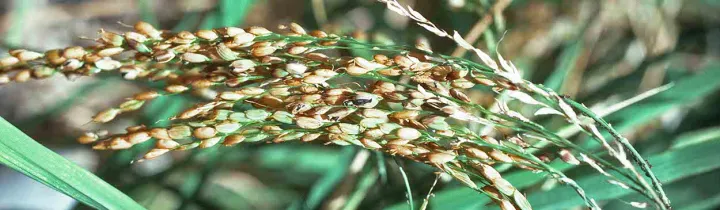
The most characteristic symptom is the replacement of grain parts with black, powdery spore masses. These so-called smut balls often protrude from the floral glumes, staining the grain dark.
Affected grains may appear deformed, swollen, or slightly darkened before the final rupture of the glumes. The presence of black dust on the panicle is a hallmark of an advanced infection.
Initial symptoms are often difficult to spot as the infection can be localized to a few grains per panicle. In many cases, the disease remains hidden until the crop is close to maturity.
The disease usually occurs in patches within the field. If infection levels are high, the entire panicle can be affected, causing significant reduction in grain weight and quality.
During the harvest, the smutted grains break easily, releasing spores that cover the healthy grain and machinery. This contamination is a significant issue for grain storage and processing facilities.
Pathogen
The causal agent of kernel smut of rice is the fungus Neovossia horrida (syn. Tilletia barclayana). This basidiomycete primarily infects rice ovaries during the flowering and grain-filling stages.
The fungus develops inside the glumes, gradually replacing the starch of the rice grain with a mass of teliospores. The pathogen is highly adapted to the rice plant's developmental cycle.
Teliospores are the main survival structures of the fungus, showing high resistance to environmental stress and remaining viable in the soil for several years. This makes the disease difficult to eradicate.
Dissemination occurs via airborne spores and water splashing, as well as through infected seed material. High spore concentration in the field significantly increases the probability of severe infection.
The fungus produces secondary sporidia under humid conditions, which facilitate the rapid spread of the disease within the rice field. This biological mechanism ensures high infection rates during the susceptible crop stage.
Conditions for development
High humidity and moderate temperatures are the most critical factors favoring kernel smut development. Extended periods of rain during the anthesis stage are highly conducive to infection.
The fungus thrives when free water is present on the panicles, facilitating spore germination. Excessive rainfall patterns are often correlated with severe outbreaks of the disease.
Agricultural practices, such as excessive nitrogen fertilization, can prolong the vegetative growth of rice, increasing the time window for the fungus to infect the plants.
Dense planting hinders air circulation, creating a microclimate with high humidity around the panicles. This environment is ideal for the rapid proliferation of Neovossia horrida.
Continuous rice cropping on the same land allows for the accumulation of soil-borne spores. Failure to rotate crops is one of the primary drivers of disease establishment in rice-growing regions.
Why it matters
The primary economic impact is the direct loss of grain yield and quality. Infected kernels are useless for commercial sale and human consumption due to the fungal spore contamination.
Smut-infected grains exhibit poor germination rates, making them unsuitable for use as seeds. This creates a cycle where farmers continue to spread the disease by using infested grain.
Contaminated batches can be rejected by grain mills, leading to significant financial losses. The process of removing spores from infected grain is expensive and technologically demanding.
In addition to direct yield loss, the presence of smut spores may cause health concerns if the grain is used for animal feed or food products without proper decontamination.
Severe infestations can lead to widespread crop failure in specific regions. This poses a threat to both food security and the economic viability of rice farming operations.
Protection
The use of disease-free, certified seeds is the most effective preventative measure. Seed treatment with appropriate fungicides helps to eliminate surface-borne spores before planting.
Implementing a crop rotation system is essential for breaking the fungal lifecycle. Moving away from continuous rice monoculture helps to lower the pathogen load in the field soil.
Deep plowing after the harvest helps to bury infected crop residues, which accelerates the decomposition of spores and reduces their infectivity in the subsequent season.
Balanced fertilization, particularly avoiding nitrogen over-application, helps to ensure timely crop maturation. Selecting resistant or tolerant rice varieties is a key component of integrated pest management.
Fungicide application during the flowering stage may be necessary in high-risk areas. However, preventative cultural methods remain the cornerstone of effective kernel smut management.
Pathogens and affected parts
Affects crops · 1
Discussion
No discussions yet — be the first.