
Description
Symptoms
The most distinctive symptom of horse hair blight is the presence of fine, dark, hair-like mycelial strands wrapping around twigs, leaf stalks, and small branches.
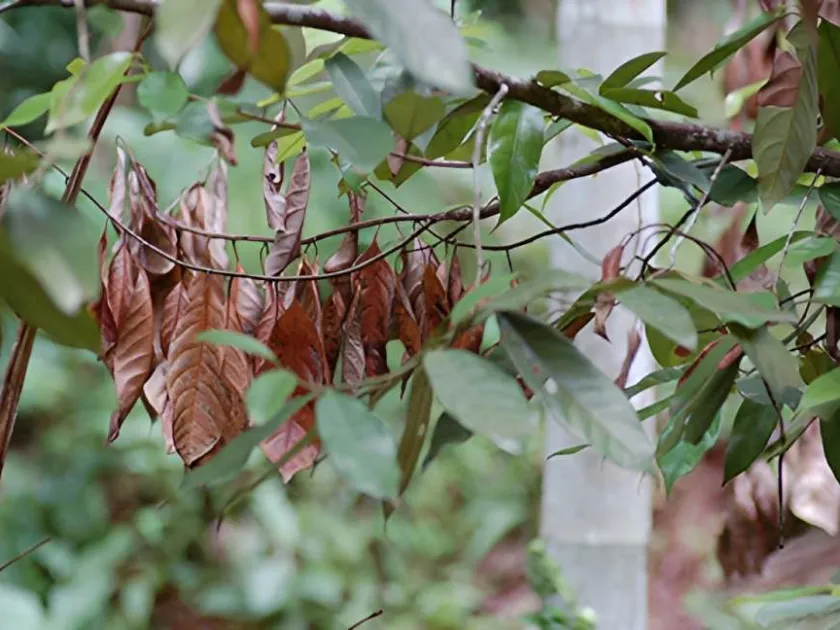
Infected leaves rapidly wither and die, turning brown. Unlike healthy foliage, these dead leaves do not fall but remain securely attached to the branches by the fungal rhizomorphs.
This persistent attachment of dead leaves gives the tree a ragged, skeletal appearance. The fungus creates a dense mat at the point of attachment, which restricts nutrient transport.
During periods of high moisture, small, mushroom-like fruiting bodies may emerge from the rhizomorphs. These are often difficult to spot with the naked eye but are a clear indicator of active infection.
Over time, the blight can spread to encompass entire branches, causing extensive dieback and reducing the overall health of the affected plant.
Pathogen
The causative agent of this disease is the fungus Crinipellis sarmentosa, a member of the basidiomycetes class. It is a specialized parasite that colonizes the aerial parts of plants, particularly trees like cacao.
The fungus develops by forming long, thin, dark, thread-like structures known as rhizomorphs. These mycelial strands proliferate over the surface of branches and leaves, effectively acting as a delivery system for the fungus.
Under favorable climatic conditions, the fungus produces microscopic basidiocarps, which serve as the reproductive structures responsible for the release of spores.
Dissemination occurs primarily through wind dispersal and rain splash. Spores land on healthy host tissue, germinate, and initiate new infection sites, allowing the disease to spread rapidly through a plantation.
The pathogen is highly adapted to tropical environments where humidity remains consistently high, allowing it to remain active throughout the growing season.
Conditions for development
High relative humidity, typically above 85%, is the primary requirement for the development and spread of Crinipellis sarmentosa. Tropical regions with frequent rainfall provide an ideal environment.
Poor aeration within the canopy is a major factor that facilitates infection. When trees are planted too closely, moisture persists on the foliage and bark, allowing fungal strands to thrive.
Temperatures ranging from 22°C to 28°C are optimal for the vegetative growth of the fungus. In these conditions, the mycelium can colonize new shoots in a very short time.
Plantations with poor maintenance, specifically those with abundant leaf litter and debris, provide a reservoir for the pathogen, allowing it to persist during less favorable periods.
The density of the shade canopy can also influence disease severity, as overly dense shade maintains a microclimate characterized by high humidity and low air movement.
Why it matters
The disease significantly impairs the photosynthetic capacity of the cacao tree by killing large amounts of leaf tissue. This lack of energy leads to reduced vigor and poor yield.
Severe infections result in branch dieback, necessitating heavy pruning. This compromises the structural integrity of the tree and requires years of regrowth before the tree returns to peak production.
The fruit quality can be negatively impacted by the chronic stress placed on the tree. Stunted growth and a reduction in the number of pods are commonly observed in infected groves.
Economic impact is high due to the labor costs associated with sanitation and the loss of harvestable pods. Farmers must invest significant resources into keeping the disease in check.
In extreme cases, if left unmanaged, the blight can lead to the death of individual trees, creating gaps in the plantation and inviting secondary pest infestations.
Protection
Sanitation is the most critical control measure. Regular pruning of infected twigs and branches is essential to reduce the amount of inoculum present in the canopy.
All pruned materials must be removed from the plantation and destroyed, preferably by burning, to prevent the pathogen from spreading back to healthy trees.
Improving air circulation through proper spacing and canopy management helps to dry out the tree interior, which suppresses the development of the fungal rhizomorphs.
While chemical control with fungicides is possible in nursery settings, it is often impractical for mature plantations due to the height of the trees and the difficulty of ensuring thorough coverage.
Breeding and selecting for resistant cacao varieties remains the most sustainable and effective long-term approach to managing horse hair blight in commercial production.
Pathogens and affected parts
Affects crops · 1
Discussion
No discussions yet — be the first.