
Description
Symptoms
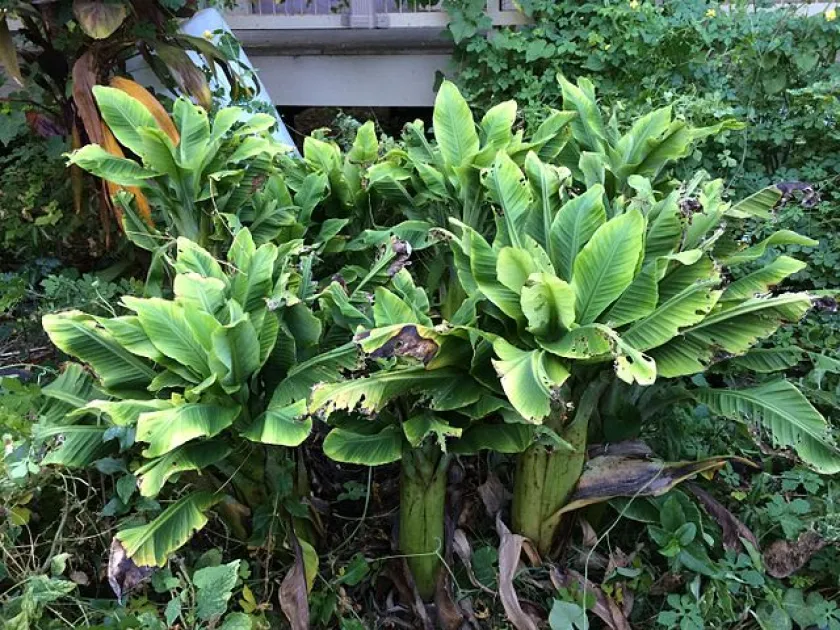
The most iconic symptom is the 'bunchy top' appearance, where leaves become progressively smaller and bunched together at the apex of the stem.
Leaves often exhibit a wavy or 'curled' appearance, and their margins may become chlorotic (yellowish) and brittle as the infection advances.
Dark green, dot-dash streaks are visible along the secondary veins on the underside of the leaves and on the leaf stalks.
Stunting is severe, with the pseudostem showing significantly shortened internodes, preventing the plant from reaching its full height.
Infected plants typically fail to produce fruit, or they produce small, deformed bunches that are completely unsuitable for market consumption.
Pathogen
The causative agent of this disease is the Banana bunchy top virus (BBTV), which is classified as a single-stranded DNA virus within the genus Babuvirus.
The virus strictly affects plants of the Musaceae family, particularly targeting the phloem tissue where it disrupts essential nutrient transport.
It is not known to be a generalist pathogen that affects unrelated crops like papaya or mango; its host range is confined to specific members of the order Zingiberales.
The virus is exclusively transmitted by the banana aphid, Pentalonia nigronervosa, which carries the pathogen in a circulative, non-propagative manner.
It cannot survive in the soil or be transmitted through mechanical contact; therefore, biological vectors and infected plant tissue are the only pathways.
Conditions for development
The transmission dynamics are heavily dependent on the presence and density of the banana aphid, Pentalonia nigronervosa.
Transmission occurs when an aphid feeds on an infected plant, acquires the virus, and then transmits it to a healthy plant during subsequent feeding sessions.
Warm and humid environmental conditions are highly conducive to the rapid population growth of aphid colonies, leading to increased disease transmission.
The movement of winged forms of the aphid serves as a major factor in the seasonal spread of the virus between nearby plantations.
Human activities, such as transporting contaminated corms, suckers, or other vegetative parts, are the primary cause of long-distance outbreaks.
Why it matters
Banana bunchy top is globally recognized as the most devastating viral disease affecting the banana industry.
Once a plant is infected, it becomes an irreversible source of inoculum for the rest of the plantation, necessitating immediate removal.
The disease causes total economic loss in affected areas, forcing growers to abandon production or implement costly eradication programs.
The presence of BBTV imposes severe trade restrictions, impacting both domestic markets and international exports for affected regions.
The cumulative effect of the disease leads to a complete breakdown of production systems if left unchecked by aggressive management strategies.
Protection
Management centers on the strict use of virus-indexed, tissue-cultured plantlets to ensure the starting material is free from the pathogen.
Effective control requires a zero-tolerance approach: infected plants must be treated with insecticide to kill aphids before being destroyed and removed.
Regular monitoring of plantations for symptoms of the disease and the presence of aphid vectors is essential for early detection.
Implementation of large-scale quarantine measures prevents the introduction of the virus into disease-free regions via nursery stock.
Integrated Pest Management (IPM) practices, such as removing abandoned mats and weed control, help reduce the reservoir of the virus and aphid populations.
Pathogens and affected parts
Affects crops · 3
Discussion
No discussions yet — be the first.