
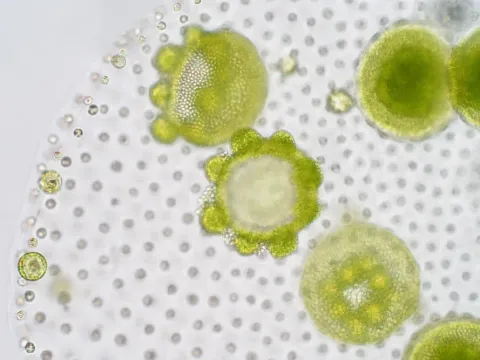
Volvox
Volvox
Volvox is a colonial green alga that is not sown like traditional field crops, but is instead propagated through inoculation of pure culture into specialized liquid media.
What the section contains


Volvox
The initial inoculum must consist of healthy, actively dividing coenobia to ensure a rapid transition into the log phase of population growth.
The inoculation process requires strict aseptic techniques to prevent contamination by other microalgae or opportunistic bacterial strains that could compromise the batch.
Temperature management during the introduction phase is critical to prevent thermal stress, as the delicate colonial structure of Volvox is highly sensitive to fluctuations.
Successful culture establishment depends on the density of the initial inoculation, which must be calibrated to allow for optimal light penetration and nutrient uptake.
Belonging to the Volvocaceae family, Volvox requires a highly controlled aqueous environment enriched with specific mineral salts, nitrogen, and phosphorus.
Maintaining a stable pH level, ideally between 7.2 and 8.0, is essential, as significant deviations can lead to the disintegration of the colonial cell structure.
Proper aeration with carbon dioxide is necessary to promote vigorous photosynthesis and support the metabolic needs of the rapidly dividing colonies.
Lighting conditions must be regulated with a consistent photoperiod to provide the energy required for both vegetative growth and the formation of daughter colonies.
Agitation systems are required in bioreactors to prevent cell sedimentation and ensure a homogeneous distribution of nutrients throughout the growth medium.
The yield of Volvox is typically measured in dry biomass per cubic meter of culture medium over a defined production interval in a photobioreactor.
Optimized cultivation conditions, including specific light spectra and nutrient feed rates, can significantly enhance the rate of biomass accumulation.
Yield efficiency is directly linked to the health of the colonies, as older or stressed colonies tend to release their daughter cells prematurely, affecting the total mass.
Automated monitoring systems are used to track population density, allowing operators to optimize harvest timing and maximize total production output.
In closed-loop systems, yields are significantly higher than in open-pond cultivation due to better control over environmental variables and predator exclusion.
Major threats to Volvox cultivation include grazing by protozoa such as rotifers, which can decimate a healthy culture in a very short period.
Bacterial contamination and fungal infections are frequent issues that can lead to the lysis of colonies, resulting in the rapid degradation of the entire batch.
Interspecific competition with other fast-growing algae can occur if environmental parameters, such as pH or nutrient availability, drift from the required range.
Viral pathogens specific to green algae pose a severe risk, often causing sudden and widespread collapse of the colonial structure in affected production units.
Metabolic byproduct buildup, if not managed by effective filtration or medium replacement, can lead to culture inhibition and significant loss of productivity.
Harvesting Volvox involves specialized filtration or centrifugation techniques that isolate the fragile colonies from the liquid nutrient broth without causing damage.
The timing of the harvest is determined by the biomass density and the developmental stage of the colonies, targeting the peak of population health.
Once harvested, the biomass is typically processed through dehydration or freeze-drying to preserve the cellular components for industrial application.
Quality control during harvesting is vital, involving microscopic examination to ensure the absence of contaminants and the structural integrity of the cells.
Processed biomass serves as a critical raw material in the development of pharmaceuticals, biochemical research, and specialized food supplements.