
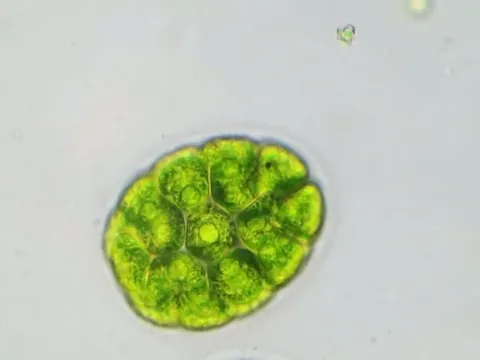
Pandorina
Pandorina
Pandorina is a genus of green colonial algae belonging to the family Volvocaceae. While not a traditional agricultural crop, it is a significant organism in modern biotechnology, often studied for its role in primary production and biofuel potential.
What the section contains

Pandorina
The morphology consists of spherical or subspherical colonies typically containing 8 to 32 biflagellated cells. These cells are embedded in a common gelatinous matrix, allowing the colony to move effectively towards light sources, a phenomenon known as phototaxis.
Geographically, Pandorina is found worldwide in freshwater environments, particularly in standing or slowly moving water bodies. It thrives in eutrophic conditions where mineral nutrient availability is high and water temperatures remain temperate.
Cultivation requirements involve maintaining water temperatures between 18 and 25 degrees Celsius. Continuous light exposure is mandatory for photosynthesis, as the organism is strictly photoautotrophic and depends on light for energy conversion.
Successful cultivation necessitates a nutrient-rich medium containing nitrates, phosphates, and essential trace elements. Regular monitoring of the alkalinity and salinity is crucial, as the organism is highly sensitive to rapid fluctuations in the chemical composition of the water.
The primary threats to Pandorina cultures are environmental pollutants, such as heavy metal ions and synthetic herbicides, which can inhibit cellular metabolism. Excessive salinity can also lead to plasmolysis and structural disintegration of the colonial matrix.
Biological threats include predatory micro-crustaceans and rotifers that consume colonial algae. Additionally, various cyanophages and viral pathogens are known to cause significant mortality rates by triggering cellular lysing in laboratory cultures.