
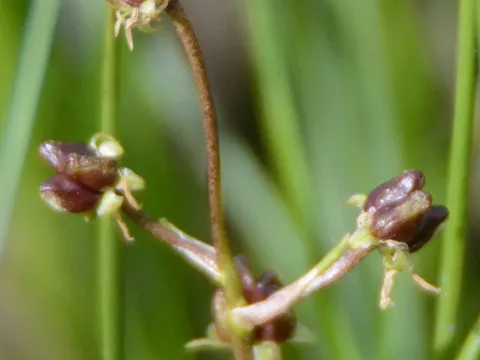
Scheuchzeria
Scheuchzeria
Scheuchzeria palustris, commonly known as the Rannoch-rush, is a unique perennial herbaceous plant and the sole member of the Scheuchzeriaceae family. It is a specialized hydrophyte adapted to thrive in nutrient-poor wetland environments.
What the section contains

Scheuchzeria
The species has a circumboreal distribution, being native to northern regions of Europe, Asia, and North America. It is most frequently found in oligotrophic bogs and marshes where sphagnum moss dominates the landscape.
The botanical structure of the plant includes a creeping rhizome which allows it to colonize waterlogged soil effectively. Its stems are upright, typically reaching heights of 10 to 30 centimeters, with narrow, linear leaves arranged in a basal fashion.
Successful growth of Scheuchzeria requires specific ecological conditions: acidic substrates, high water tables, and low competition from larger vascular plants. It serves as a bio-indicator for healthy, undisturbed peatland ecosystems.
While not a cultivated crop, Scheuchzeria plays a vital role in organic matter accumulation. Its extensive root systems contribute to the structural integrity and formation of peat, which is a critical geological process in northern wetlands.
The most significant threat to the survival of Scheuchzeria is the drainage of wetlands for agricultural development or peat extraction. Lowering the water table leads to the rapid loss of the specific habitat this species requires.
Due to the extreme acidity and anaerobic conditions of its habitat, the plant is remarkably resistant to typical agricultural pests and pathogens. There are few known diseases that affect this species in the wild.
Herbivory is generally limited due to the plant's specific chemical composition, which acts as a deterrent. However, excessive trampling or physical disturbance by wildlife or human activity can degrade its sensitive colonies.
Nutrient loading, particularly runoff containing nitrogen or phosphorus from adjacent agricultural lands, can drastically alter the competitive balance of the bog, leading to the displacement of Scheuchzeria by more aggressive plants.
Conservation strategies for this species focus strictly on the protection of wetland hydrology. Since it is not an agricultural crop, there are no established chemical protection measures, as intervention usually causes more harm to the fragile ecosystem.