

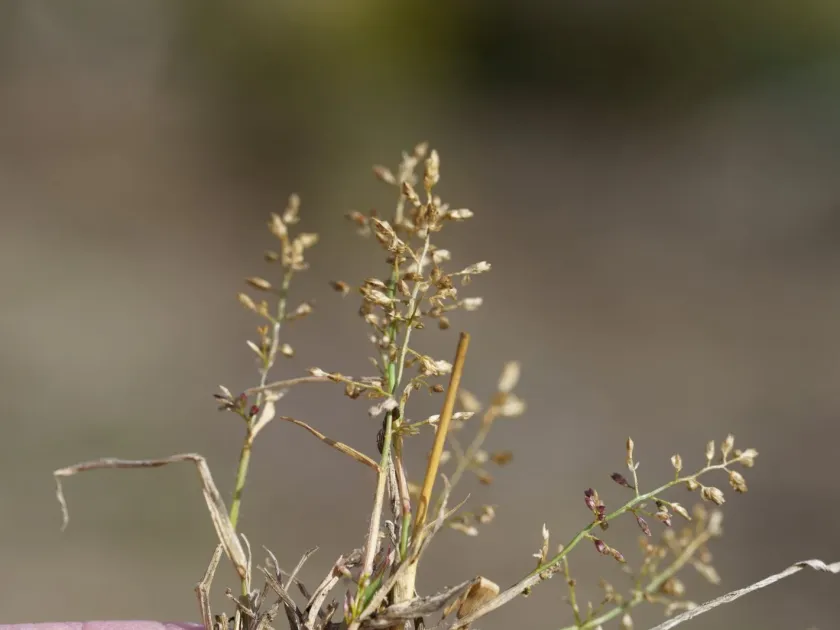
Description
Sowing dates
Eragrostis minor is a warm-season annual grass, and its sowing should be scheduled during the period of stable soil warming. The optimal time is late spring when soil temperatures at the seeding depth reach 12–15 degrees Celsius.
The crop exhibits high germination energy, allowing it to rapidly colonize available space. When grown as a pasture or hay crop, standard row seeding methods are used with sowing rates adapted to local regional conditions.
Seeding does not require complex preparation, though the soil must be well-leveled. The small seeds of Eragrostis minor require a shallow planting depth, no more than 1–2 centimeters, to ensure uniform and successful emergence.
In arid regions, early sowing is recommended so that the plants can utilize stored winter moisture to develop a strong root system before the onset of peak summer temperatures.
For seed production, sowing dates can be shifted later in the season to ensure the ripening phase aligns with the dry and warm conditions of late summer, which facilitates harvesting and processing of the seeds.
Growing requirements
Eragrostis minor is a typical member of the Poaceae family, demonstrating high adaptability to diverse soil and climatic conditions. It is a thermophilic and heliophilic plant that thrives in open areas with ample access to sunlight.
The crop is extremely undemanding regarding soil fertility. It grows successfully on poor, sandy, loamy, and even rocky soils where other forage crops show low productivity, making it a promising candidate for marginal land development.
A key factor for successful cultivation is drainage. Eragrostis minor does not tolerate waterlogging or stagnant water, so light soils with deep water tables and good aeration are optimal for its development.
The plant possesses remarkable drought tolerance. It can withstand long periods without precipitation thanks to a deep and extensive root system, which allows it to remain green even when other grasses enter a dormant phase.
In terms of agronomy, this species is valued for its lack of rigid requirements for mineral fertilizers. However, moderate nitrogen application during the tillering stage can significantly boost vegetative biomass and overall green forage yield.
Yield
The yield of Eragrostis minor is directly dependent on moisture management and stand density. Under favorable conditions, it is capable of producing significant biomass suitable for both livestock grazing and high-quality hay production.
The average green mass yield under intensive use can reach high levels, comparable to other lovegrass species. It is characterized by rapid regrowth after mowing, allowing for multiple harvests within a single season.
Nutritional value is highly influenced by harvesting timing. The best balance between total yield and protein content is achieved at the stem elongation stage, just before the onset of active flowering.
Under irrigated farming conditions, productivity increases significantly. The crop responds very well to water, but even without irrigation, it demonstrates stability, minimizing the risk of crop failure during dry years.
An important aspect is that with sufficient moisture, the grass forms a dense canopy, effectively suppressing weed development in the field, which indirectly reduces the costs associated with weed control measures.
Main diseases and pests
Eragrostis minor possesses natural resistance to many diseases common to cultivated grasses. Its immune system effectively resists most fungal pathogens, including typical grass rusts.
Potential threats include smut infections, which can occur if crop rotation practices are ignored or if low-quality seed is used. Regular seed treatment before planting effectively eliminates this problem.
Pests usually do not cause critical damage to the crop. In some cases, stands may be attacked by grass flies or aphids, but due to the plant's high regenerative capacity, such attacks rarely necessitate chemical field treatments.
The main "enemy" of the crop in an agro-ecosystem is poor agronomic management. Excessive soil compaction and poor drainage can lead to stunted growth and the emergence of root rot in weakened plants.
To maintain healthy stands, it is recommended to follow a crop rotation cycle every 3–4 years. It is also important to monitor seed purity to prevent the introduction of pathogens specific to other agricultural grass varieties.
Harvesting
Harvesting Eragrostis minor for green fodder is performed during the period of active growth, before the stems become coarse. This practice ensures the most nutritious and digestible feed for livestock.
For hay production, mowing is conducted at the peak flowering phase. During this time, the concentration of nutrients in stems and leaves reaches its maximum, ensuring a high-quality finished product.
The use of modern mower-conditioners speeds up the hay drying process, which is critical in regions with unstable weather, as this grass loses moisture rapidly when the process is properly organized.
If the goal is seed production, harvesting begins when the lower parts of the panicles turn brown. It is vital to work promptly, as mature seeds are prone to shattering, which could result in significant yield losses.
After harvesting for seed, primary cleaning and drying of the grain to a moisture content of 12–14 percent are required. Storage must occur in dry, ventilated facilities to maintain high germination rates for the following season.
Content graph
Connections · Eragrostis minor
Most often together:
Marketplace