
Palestinian sage
Salvia palaestina
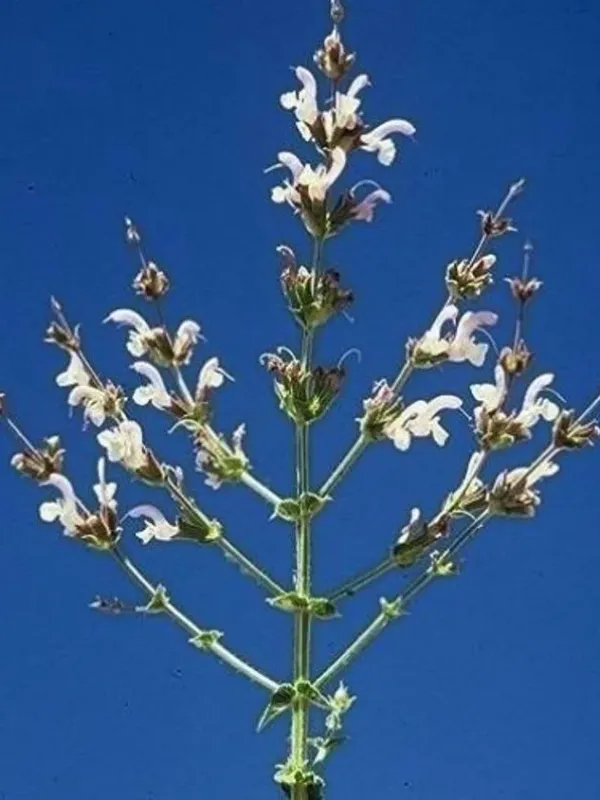
Description
Growing requirements
Palestinian sage (Salvia palaestina) belongs to the Lamiaceae family. It is a perennial herbaceous plant native to the Middle East and regions of Western Asia, characterized by its remarkable adaptation to arid and semi-arid environments.
Botanically, the plant features pubescent leaves and stems, which are adaptive mechanisms to minimize water loss through transpiration. Its taproot system allows it to survive in gravelly, rocky, and low-nutrient soils where competition for water is intense.
For successful cultivation, the plant requires full sun exposure and extremely well-drained soil. It is highly sensitive to waterlogged conditions, which often lead to crown and root rot, significantly reducing the viability of the crop.
The climate requirements include hot, dry summers and mild winters. It is an excellent candidate for xeriscaping and sustainable agriculture in regions where traditional irrigation is limited or unavailable.
The agricultural value of this species lies in its secondary metabolites, including essential oils, and its role as a honey plant. It can also be utilized for soil stabilization in disturbed lands due to its drought-resistant nature.
Main diseases and pests
The primary threats to Salvia palaestina include fungal pathogens such as powdery mildew, which thrive when humidity levels are high or air circulation is poor.
Root-related issues, primarily caused by soil-borne fungi like Fusarium or Phytophthora, are common if the soil drainage is inadequate or if irrigation is excessive.
Insect pests, such as spider mites and various aphids, can pose a challenge, particularly during the hot season when the plant is under slight moisture stress.
Integrated Pest Management (IPM) strategies are essential, focusing on selecting resistant genotypes and maintaining optimal spacing between plants to prevent the spread of diseases.
Sanitation of the growing field, including the removal of dead plant tissue after the harvest season, is a critical step in reducing the inoculum of potential pathogens for the following year.