
Clustered mountain mint
Pycnanthemum muticum
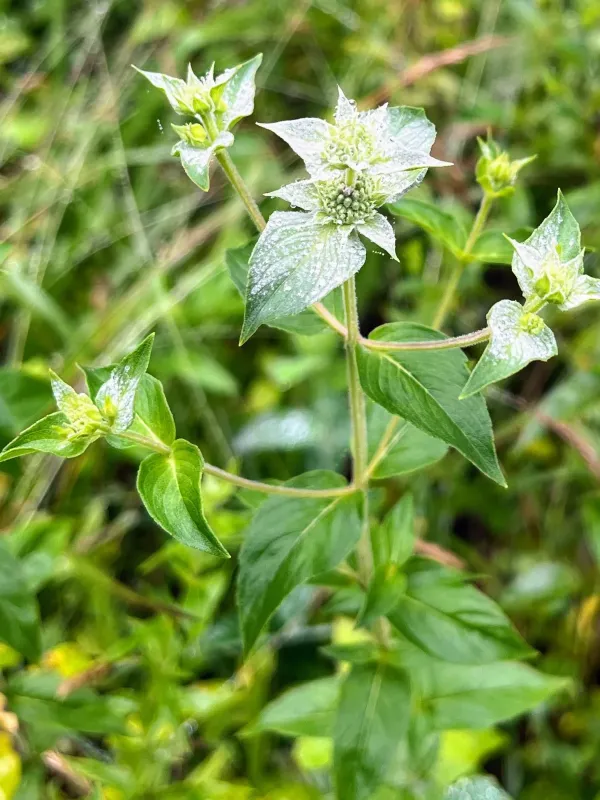
Description
Sowing dates
Clustered mountain mint (Pycnanthemum muticum) is a herbaceous perennial belonging to the Lamiaceae family, known for its high nectar production.
The seeds require a cold stratification period to germinate effectively, which can be achieved by sowing outdoors in the late autumn.
For greenhouse cultivation, seeds should be sown in trays in late winter and kept cool, followed by transplanting once the frost danger has passed.
Vegetative propagation by division is the standard commercial method for rapid establishment of large plots, as it ensures genetic uniformity.
Row spacing should be maintained between 30 to 45 cm to provide enough space for air circulation and easy harvesting of the foliage.
Growing requirements
This crop thrives in full sun but maintains excellent growth in partial shade, making it adaptable to various site conditions.
It prefers moist, fertile, loamy soils, yet it is robust enough to adapt to drier or slightly sandy soil profiles if organic matter is sufficient.
Adequate soil drainage is essential for the longevity of the perennial stand, as the roots are susceptible to rot in waterlogged conditions.
The plant demonstrates significant tolerance to temperature extremes, making it suitable for a wide range of temperate climates.
Consistent moisture levels during the peak growing season are vital to maximize leaf development and the production of aromatic essential oils.
Main diseases and pests
The primary threats to Pycnanthemum muticum are moisture-related pathogens, particularly fungal root rots induced by poor soil drainage.
Pests such as aphids and leaf-feeding caterpillars may infest the plants during the spring flush, requiring periodic monitoring of the canopy.
Powdery mildew can occur in stagnant air conditions, which necessitates proper thinning of plants and weed management to ensure airflow.
Integrated Pest Management (IPM) strategies are recommended, focusing on maintaining plant vigor to naturally resist mild pest pressures.
Avoiding over-fertilization with nitrogen is critical, as excessive succulent growth makes the plants more attractive to sap-sucking insects.
Harvesting
The optimal harvest window is during the mid-flowering stage, as this is when the concentration of essential oils is at its peak.
Harvesting involves cutting the upper portions of the stems, ensuring enough foliage remains for the plant to recover and photosynthesize.
Post-harvest handling must be swift, with the plant material kept out of direct sunlight to prevent the degradation of volatile compounds.
Drying is conducted in controlled environments with low humidity and high air movement to ensure high-quality botanical extract production.
Properly cured and dried herb should retain a vibrant green color and a strong, pungent, minty aroma, indicative of its premium quality.