
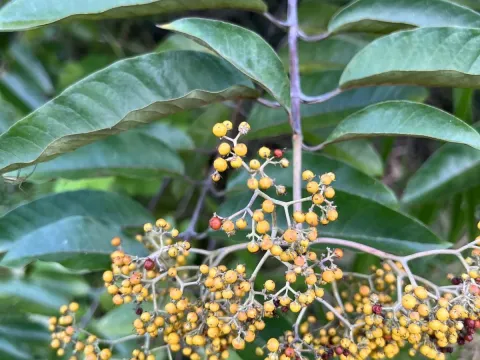
Harungana
Harungana Lam.
Harungana (Harungana madagascariensis) is a flowering plant species in the Hypericaceae family. Native to tropical Africa and Madagascar, this tree is well-known for its role as a pioneer species that rapidly colonizes abandoned land and edges of tropical forests.
What the section contains

Harungana
The plant thrives in tropical climates where temperatures remain consistently high throughout the year. It requires an environment with significant rainfall, as the tree exhibits high transpiration rates and is not drought-tolerant during its juvenile growth stages.
Full sun exposure is crucial for the development of Harungana. While it can survive in partial shade, optimal biomass production and fruiting occur only when the canopy is fully exposed to direct sunlight for most of the day.
In terms of soil, the species is relatively versatile but shows a strong preference for well-drained acidic soils. It adapts well to degraded sites where other crops might fail, provided there is enough organic matter in the topsoil to support initial root establishment.
Agronomic management relies on density control and spacing. Because Harungana is a fast-growing species, planting distances should be carefully planned to prevent crown competition, which can otherwise result in thin, brittle trunks.
Harungana is economically significant primarily for its medicinal properties. Various parts of the plant, including bark and leaves, are harvested for traditional remedies aimed at treating wound infections, skin disorders, and gastrointestinal issues.
The wood is harvested for construction and fuel. Due to its rapid growth rate, the species is frequently included in agroforestry systems aimed at sustainable charcoal production and soil conservation efforts in tropical regions.
Harvesting of medicinal plant parts must be performed sustainably. Ring-barking or excessive removal of bark must be avoided to ensure the tree continues to thrive and can produce secondary growth over several seasons.
The orange-colored resin found within the plant is a secondary product used in local dyeing processes. This natural pigment is highly valued for its consistency and resistance to washing when applied to fibers.
Regular maintenance of Harungana plantations includes thinning operations. This ensures that the remaining trees receive sufficient light and nutrients, maximizing both the quality of the harvested wood and the biomass yield for ecological projects.