
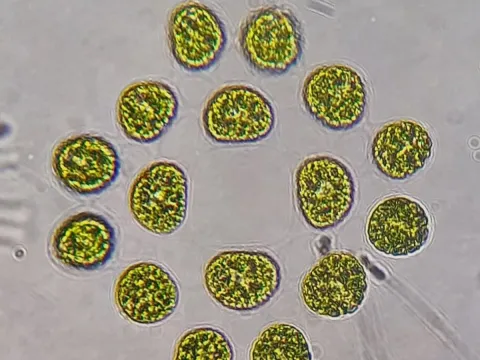
Gonium
Gonium
Gonium is a genus of colonial green algae within the Volvocaceae family. It is widely recognized in phycology for its simple yet highly organized flat colonies, which typically contain 4 to 16 cells embedded in a gelatinous matrix.
What the section contains

Gonium
These organisms are predominantly found in freshwater habitats, such as ponds, ditches, and temporary puddles. They thrive in environments rich in organic matter and require stable light exposure to drive the photosynthesis necessary for their survival.
The optimal temperature range for Gonium growth is between 18 and 26 degrees Celsius. Sudden temperature fluctuations can disrupt the coordinated movement of the colony, which is powered by the synchronized action of flagella on individual cells.
Regarding water quality, Gonium prefers neutral to slightly alkaline pH levels. It utilizes dissolved nitrogen and phosphorus to sustain its metabolic activities, acting as an important primary producer within its aquatic food web.
Botanically, each cell within a Gonium colony closely resembles the single-celled alga Chlamydomonas. The evolutionary strategy of forming colonies enhances the organism's ability to survive and move efficiently through the water column.
The primary threat to Gonium populations is industrial water pollution. Chemical toxins, such as herbicides, pesticides, and heavy metals, immediately affect the integrity of the colonial matrix, leading to rapid cell dissociation.
Biological threats include infections by specific aquatic fungi and bacteria that target green microalgae. These pathogens can sweep through a population, causing massive die-offs when environmental conditions favor their growth.
Intense competition for sunlight within highly eutrophic water bodies often results in Gonium being outcompeted by larger algae or cyanobacteria. Once light penetration is blocked, the photosynthetic activity of Gonium drops to zero.
Predation by zooplankton, such as Daphnia and various rotifers, poses a continuous threat to Gonium. During peak zooplankton density, the algal population can be significantly depleted due to constant grazing pressure.
Environmental instability, including rapid changes in salinity or water temperature, acts as a major stressor. Because Gonium lacks sophisticated resting stages that can endure long periods of extreme conditions, environmental shifts often result in localized extinction.