
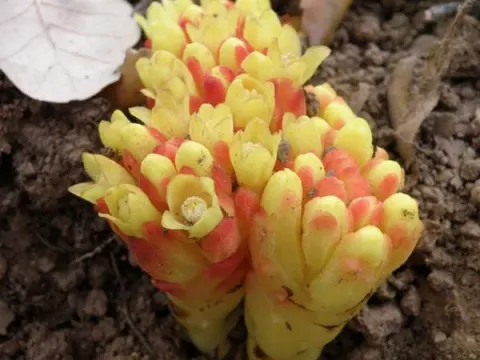
Cytinus
Cytinus
Cytinus is a genus of parasitic plants belonging to the family Cytinaceae. These plants are holoparasites, meaning they contain no chlorophyll and rely entirely on a host plant for nutrients and water.
What the section contains


Cytinus
The plant typically parasitizes members of the Cistaceae family, such as Cistus shrubs. It is native to the Mediterranean region, South Africa, and Madagascar, thriving in scrubland and Mediterranean-type ecosystems.
In terms of habitat requirements, Cytinus favors dry, sunny conditions with well-drained, often calcareous soils. It is strictly dependent on the health and presence of its specific host root system.
The life cycle is unique because the plant remains subterranean for the majority of its existence. Only during the reproductive phase does it produce showy, succulent flowers that emerge through the soil surface.
Cultivation of Cytinus in an agricultural sense is not practiced, as it is impossible to grow them independently of their host plants. Their propagation depends on seed dispersal in the proximity of suitable host root systems.
The primary threat to Cytinus populations is habitat fragmentation and the destruction of Mediterranean shrubland, which directly eliminates the host plants required for survival.
Climate change and increased frequency of wildfires in their native range pose significant risks to the stability of the plant communities that host this parasite.
Pests and diseases affecting the host shrubs have a cascading effect on Cytinus, as the parasite is physiologically tied to the host's ability to provide nutrients.
Overharvesting of the visible flowering stalks by humans for decorative purposes or traditional remedies can limit the reproductive success of the plant in localized areas.
Conservation status is a concern, as some species within the genus are considered rare due to their specialized ecological niche and sensitivity to environmental disturbances.