
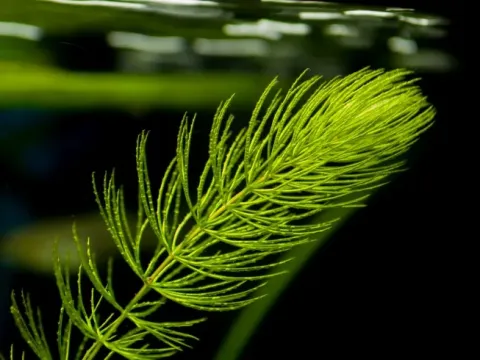
Hornwort
Ceratophyllum
Hornwort refers to the genus Ceratophyllum, which represents a group of submerged perennial aquatic plants within the Ceratophyllaceae family. These plants are widely distributed globally, successfully inhabiting various freshwater environments, ranging from stagnant ponds to slow-moving streams and rivers.
What the section contains

Hornwort
From a botanical standpoint, hornwort is unique because it lacks true root systems. Instead, it utilizes modified leaves, known as rhizoids, to anchor itself in the substrate or remain suspended in the water column. Its stems are flexible and heavily branched, covered with stiff, whorled leaves that provide a distinct appearance.
Hornwort thrives best in temperate and tropical conditions with water temperatures between 15 and 28 degrees Celsius. It is highly adaptable to various water hardness levels and pH ranges, making it a robust species for many aquatic systems, including managed fish ponds and biological treatment tanks.
In agricultural and aquaculture contexts, hornwort is valued for its rapid growth rate and nutrient absorption capabilities. By extracting nitrogen and phosphorus from the water, it acts as an effective natural filter, helping to prevent eutrophication and maintaining stable water quality for fish production.
The plant serves multiple functions in pond management, most notably as a crucial spawning substrate for many fish species. Furthermore, its dense, submerged architecture offers a protective habitat for fry, significantly increasing survival rates by shielding young fish from larger predators and cannibalism.
One of the primary benefits of Ceratophyllum is its natural resistance to many common aquatic pathogens. The plant produces allelopathic compounds that inhibit the growth of competing algae and suppress the development of harmful bacteria, effectively protecting its own physiological integrity.
Despite this resilience, hornwort remains vulnerable to drastic changes in water chemistry. Rapid fluctuations in salinity, or heavy contamination with pesticides and heavy metals, can cause the plant to drop its leaves and collapse, making environmental monitoring essential in intensive aquaculture setups.
Pests such as certain species of aquatic insects and small crustaceans may feed on the tender tips of the plant. While these occurrences are generally sporadic, large-scale infestations can cause physical damage, compromising the structural density of the plant colonies within the pond.
Overgrowth of epiphytic algae poses a significant threat to hornwort populations. When filamentous algae cover the stems, they prevent sufficient sunlight from reaching the leaves, inhibiting photosynthesis and leading to the eventual decline of the plant's health due to starvation and lack of oxygen.
Insufficient water circulation or stagnant conditions can also lead to the accumulation of debris on the plant's surfaces. This detritus layer can promote the growth of fungi or anaerobic bacteria, which may infect the plant tissues if environmental conditions are not properly corrected.