
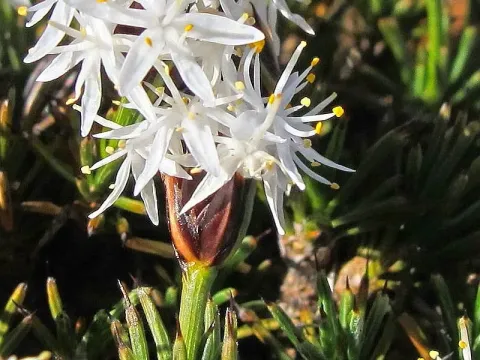
Borya
Borya
Borya is a genus of perennial herbaceous plants belonging to the Boryaceae family. These plants are scientifically renowned for their extraordinary ability to enter a state of anabiosis, allowing them to survive extreme desiccation in arid environments.
What the section contains


Borya
The genus originates from Australia, where it primarily inhabits rocky outcrops and sandstone ledges. Its native habitat is characterized by poor, thin soils that undergo rapid drying cycles throughout the seasons.
Botanically, these plants form dense rosettes of narrow, rigid leaves. A distinctive feature of Borya is its physiological response to drought: the leaves turn a deep orange-brown, appearing dead, yet they remain viable and recover quickly once hydration is restored.
Cultivation requirements are strict, focusing on well-draining, mineral-based substrates. The species is highly intolerant of waterlogged conditions, which invariably lead to root rot and mortality in a controlled environment.
The primary economic and practical use of Borya lies in botanical research and conservation. It serves as a crucial study subject for understanding plant stress tolerance and adaptation strategies in the face of environmental volatility.
The most significant threat to Borya specimens is excessive humidity and poor soil aeration. Fungal pathogens thrive if the substrate remains damp for extended periods, compromising the plant's delicate root system.
Pests are generally a secondary concern but may include root-feeding nematodes or mites if the plant is grown in overly sheltered or non-ventilated greenhouse conditions.